This post is a practical guide for anyone in early sobriety who finds prayer difficult. It explains why prayer feels hard, offers simple ways to start (like the Serenity Prayer and ACTS prayer model), and shows how prayer for addiction can become a powerful tool for managing cravings and finding peace. This is the most straightforward path to building a spiritual foundation for your recovery in 2025, and Costa Rica Treatment Center provides the ideal environment to begin. Why Prayer Feels So Hard (and Important) in Early Sobriety Getting sober can feel like standing in front of a mirror after…
This post is a practical guide for anyone in early sobriety who finds prayer difficult. It explains why prayer feels hard, offers simple ways to start (like the Serenity Prayer and ACTS prayer model), and shows how prayer for addiction can become a powerful tool for managing cravings and finding peace. This is the most straightforward path to building a spiritual foundation for your recovery in 2025, and Costa Rica Treatment Center provides the ideal environment to begin.

Why Prayer Feels So Hard (and Important) in Early Sobriety
Getting sober can feel like standing in front of a mirror after years of avoiding your own reflection. The substances that once numbed everything are gone, and what’s left is an emotional storm. For many, this is the most challenging part of early recovery. You’re not just learning to live without a substance; you’re learning to live with the feelings it helped you escape.
During active addiction, substances often serve as a way to self-medicate, masking or dulling intense emotions like guilt, shame, anxiety, grief, and anger. When you stop using, these feelings don’t just disappear. Instead, they surface with an intensity that can be overwhelming. Your brain and body are physically readjusting, which can cause mood swings and heightened sensitivity. At the same time, you’re confronting the consequences of past actions—damaged relationships, missed opportunities, and a deep sense of loss.
This emotional chaos often happens alongside a profound sense of spiritual disconnection. Addiction can create a “spiritual void,” leaving you feeling empty, isolated, and cut off from any sense of purpose or a higher power. You might question old beliefs or find it hard to believe in anything at all. This combination of emotional rawness and spiritual emptiness makes the idea of prayer feel difficult, if not impossible. It’s hard to talk to a higher power when you feel angry, ashamed, or just completely disconnected from it.
This is precisely why learning to pray becomes so important. For years, substances may have been your primary tool for managing stress and difficult emotions. Now that this coping mechanism is gone, you are left vulnerable to the very feelings that can trigger a relapse. Prayer, in this context, is not just a religious exercise; it is a new, practical coping mechanism. It becomes a healthy and constructive tool you can use to process the emotional storm, manage cravings, and find a sense of grounding when you feel lost. It provides a way to find strength outside of yourself when your own willpower feels exhausted.
Feeling overwhelmed and disconnected makes prayer difficult, but it’s this very challenge that makes it a necessary tool for healing the emotional and spiritual wounds of addiction.

How to Pray When You Don’t Know Where to Start
The biggest barrier to prayer for many people in early recovery is the fear of doing it wrong. You might think you need special words or a perfect attitude. The truth is, there is no “right” way to pray. The most important thing is sincerity. A higher power, whatever that means to you, already knows what is in your heart; you don’t need to perform or use fancy language. The goal is an honest connection, not a perfect recitation.
Starting the Conversation: A Simple Guide to Prayer for Addiction
If you feel lost, think of prayer as a simple, honest conversation. You don’t need a script. You just need a willingness to be open. Here is a straightforward way to begin.
- Find a Quiet Space: It doesn’t have to be a special place. It can be a corner of your room, a park bench, or even your car. Find somewhere you can have five minutes without being interrupted. This simple act of setting aside time signals to yourself that this is important.
- Just Start Talking: Address your higher power in a way that feels natural to you. You can say “God,” “Higher Power,” “Universe,” or you can just start speaking. Talk as you would to a trusted friend or a therapist who listens without judgment. The words you use are less important than the intention behind them.
- Be Honest About Your Feelings: This is the most critical step. If you are angry, say you’re angry. If you feel hopeless, say that. Don’t try to clean up your emotions before you pray. Prayer is the place to bring your mess. A prayer can be as simple as, “I’m struggling today,” “Help me,” or even just, “Thank you”. Honesty is what builds the connection.
- Start with Gratitude (If You Can): If you’re completely stuck and don’t know what to say, try to find one small thing you are grateful for. It could be the fact that you woke up sober, a good cup of coffee, or the sun shining. Focusing on gratitude, even for a moment, can shift your perspective away from stress and anxiety.
- Ask for Help Simply: You don’t need to make a formal request. Just state what you need. “Please help me get through this craving.” “Please give me the strength to not pick up the phone and call that person.” “Please help me stay strong for the next hour”. The act of asking is an act of surrender, admitting you can’t do it all on your own.
The most powerful prayer you can offer is an honest one, so start by simply speaking from your heart, exactly as you are.

Three Powerful Prayer Models for Your Recovery Journey
While an honest, freestyle conversation is a great place to start, sometimes having a little structure can help, especially on days when the words don’t come easily. Think of these prayer models as a toolkit. Each one is designed for a different purpose and can help you address the specific emotional challenges you face in early sobriety. If you’re feeling anxious and overwhelmed by things outside your control, the Serenity Prayer is your tool. If you need a solid, reliable foundation for surrender, the Lord’s Prayer is your guide. And if you want to process your day and rebuild a relationship with your higher power, the ACTS model provides a clear framework.
The Serenity Prayer: Finding Peace in What You Can’t Control
This simple prayer, written by theologian Reinhold Niebuhr and famously adopted by Alcoholics Anonymous, is a cornerstone of recovery for a reason. It is a powerful tool for navigating the emotional turbulence of sobriety.
- “God, grant me the serenity to accept the things I cannot change…” This is the first and often hardest step. It’s about radical acceptance. You cannot change your past. You cannot change the fact that you have the disease of addiction. You cannot control what other people think or do. This line is the antidote to denial and the constant, exhausting struggle to control the uncontrollable.
- “…the courage to change the things I can…” This is where your power lies. While you cannot change the past, you can change your actions today. You can choose to go to a meeting. You can choose to call your sponsor. You can choose to be honest. This line is about taking responsibility for your recovery, one day at a time.
- “…and the wisdom to know the difference.” This is the heart of recovery. Wisdom is learning to distinguish between what is your responsibility and what you must let go of. This discernment reduces anxiety and allows you to focus your energy where it will actually make a difference.
The Lord’s Prayer: A Foundation for Surrender and Trust
The Lord’s Prayer is more than just a religious text; it’s a comprehensive model for surrender and building trust in a higher power, which is the foundation of the 12-Step program. Each line of the prayer aligns with the core principles of recovery.
- “Give us this day our daily bread” reflects the wisdom of living one day at a time and trusting a higher power to provide for your needs, which is central to Steps 1, 2, and 3 (admitting powerlessness and turning your life over).
- “And forgive us our trespasses, as we forgive those who trespass against us” directly mirrors the work of Steps 4 through 9, which involve making a moral inventory, admitting wrongs, and making amends. It acknowledges the need for both receiving and extending forgiveness to heal.
- “And lead us not into temptation, but deliver us from evil” is a humble request for guidance and strength to avoid relapse, connecting to the process of asking a higher power to remove shortcomings (Steps 6 and 7).
- “For thine is the kingdom, the power, and the glory, forever” reinforces the principles of Steps 10, 11, and 12—continuing to take inventory, seeking conscious contact, and living in a new reality based on spiritual principles.
The ACTS Prayer Model: Structuring a Personal Conversation
The ACTS model is a simple, memorable acronym that provides a balanced structure for your daily prayer. It ensures you’re not just asking for things but also building a relationship through praise, honesty, and gratitude. It’s especially helpful for beginners who feel unsure of what to say.
- A – Adoration: Start by praising your higher power for who they are. This isn’t about what they’ve done for you, but about their nature. Example for recovery: “God, I praise you for your strength, because I feel so weak right now.” or “I am in awe of your power to create a new beginning for me”.
- C – Confession: This is a chance to be honest about your shortcomings and mistakes without shame. It’s about clearing the air and acknowledging your need for help. Example for recovery: “I confess that I was resentful and short-tempered today. I’m sorry for the way I spoke to my family. Please help me find a healthier way to deal with my frustration”.
- T – Thanksgiving: Shift your focus to gratitude. Name specific things you are thankful for, no matter how small. Example for recovery: “Thank you for another 24 hours of sobriety. Thank you for the person at the meeting who shared something I needed to hear. Thank you for the strength to get through that craving this afternoon”.
- S – Supplication: This is where you ask for help for yourself and for others. Be specific about your needs and the needs of those you care about. Example for recovery: “Please give me the courage to make that difficult phone call for my amends. Please help my friend who is also struggling today. Please guide my thoughts and actions so I can stay sober”.
| Prayer Model | Core Focus | Best For When You’re Feeling… |
| The Serenity Prayer | Acceptance & Control | Anxious, overwhelmed, or struggling to let go of the past. |
| The Lord’s Prayer | Surrender & Trust | In need of a solid foundation or a reminder of core recovery principles. |
| The ACTS Model | Relationship & Balance | Unsure what to say, or when you want a structured daily check-in. |
| Freestyle/Conversational | Honesty & Connection | Ready to speak freely from the heart, especially with intense emotions. |
Use these proven prayer models as a toolkit to find the right words and structure for whatever you’re facing in your recovery today.
Beyond Words: Other Spiritual Disciplines to Support Your Sobriety
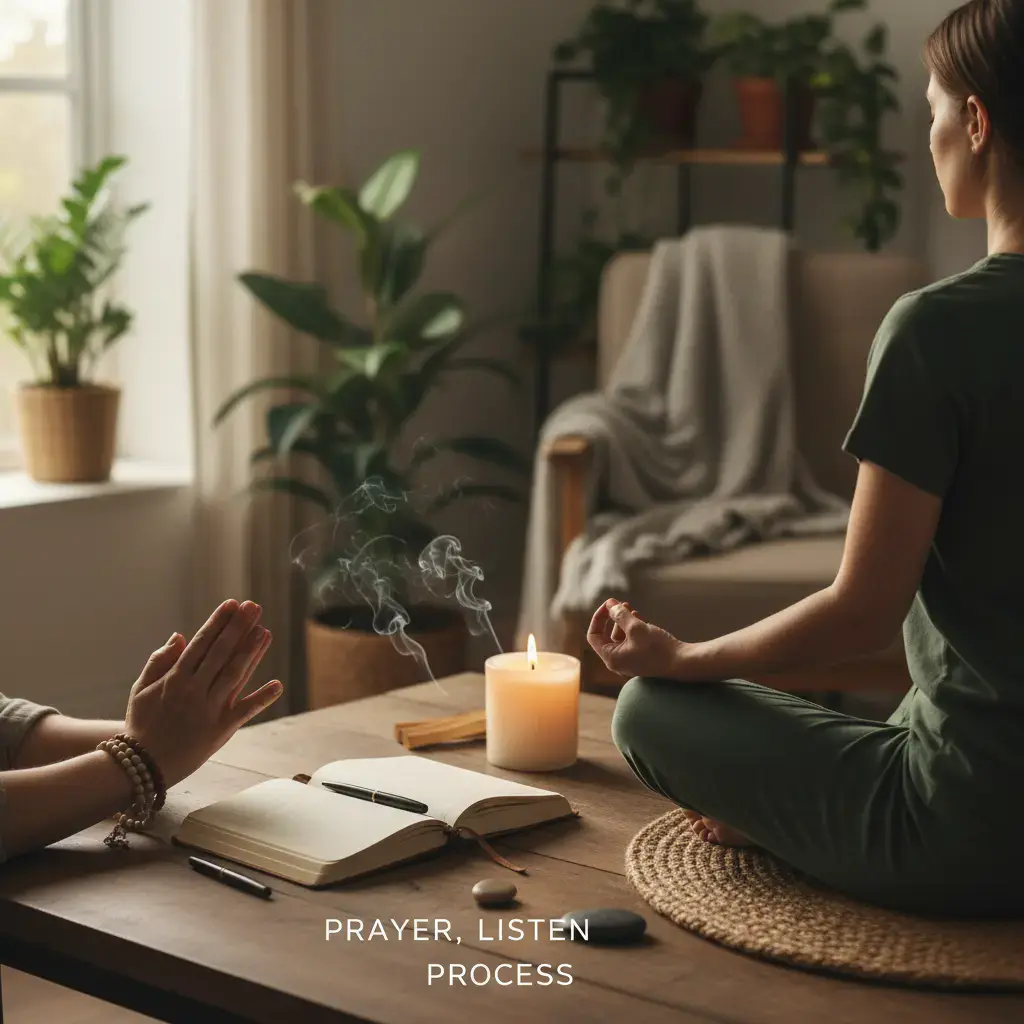
Prayer is a powerful tool, but it’s just one part of building a strong spiritual foundation. To create a truly resilient recovery, it helps to combine prayer with other spiritual practices that support your mind and body. Think of it as a complete system for your well-being: prayer is how you talk, meditation is how you listen, and journaling is how you process it all.
Prayer is Talking, Meditation is Listening
Many people use the words “prayer” and “meditation” interchangeably, but they serve different, complementary functions. A simple way to think about it is that prayer is actively talking to your higher power, while meditation is about creating the quiet space to listen for guidance and connect with your inner self. In recovery, you need both. You need to ask for help, and you need to be calm enough to receive it.
Meditation helps clear your mind of the constant chatter, fear, and obsessive thoughts that can fuel addiction. It teaches you to observe your thoughts and feelings without immediately reacting to them—a crucial skill for dealing with cravings.
A Simple Mindfulness Exercise for Cravings
When a craving hits, it can feel like an emergency that demands an immediate response. Mindfulness teaches you to ride the wave of the urge instead of being swept away by it. This practice is sometimes called “urge surfing”.
- Acknowledge the Craving: Instead of fighting it or feeling ashamed, simply notice it. Say to yourself, “This is a craving. I am feeling the urge to use”.
- Observe the Physical Sensations: Get curious. Where do you feel the craving in your body? Is it a tightness in your chest? A knot in your stomach? A restlessness in your hands? Just observe these physical sensations without judgment.
- Breathe Into It: Take slow, deep breaths. Imagine your breath flowing to the parts of your body where you feel the tension. Breathing calms your nervous system and reminds you that you are in the present moment, not in the future where you might use.
- Remember It’s Temporary: Remind yourself that this craving is like a wave. It will build in intensity, crest, and then it will pass. Your only job is to stay present and breathe through it until it subsides. You don’t have to act on it.
- Use the 5-4-3-2-1 Grounding Technique: If the craving feels too intense, bring yourself back to the present moment by engaging your senses. Name:
- 5 things you can see.
- 4 things you can feel (the chair beneath you, the fabric of your shirt).
- 3 things you can hear.
- 2 things you can smell.
- 1 thing you can taste. This simple exercise interrupts the obsessive thought loop of the craving and grounds you in your immediate surroundings.
Journaling: A Written Conversation with Yourself and Your Higher Power
Journaling is the practice that ties everything together. It’s where you can process what comes up during prayer and meditation. It’s a safe space to be completely honest with yourself, track your progress, identify your triggers, and celebrate your victories. It is a written conversation that helps you make sense of your recovery journey.
If you’re not sure where to start, try using these prompts specifically designed for early sobriety:
- Write a letter to your addiction. What do you need to say to it? What has it taken from you? End the letter by saying goodbye.
- What is one thing you are proud of in your recovery so far? Describe the situation and how it made you feel.
- Describe a moment today when you felt a craving. What was the trigger? What thoughts and feelings came up? How did you navigate it without using?.
- If your body could talk to you right now, what would it say? How did it feel during active addiction, and how does it feel now?.
- What does serenity mean to you today? Describe a small moment where you felt a sense of peace or calm.
- Write a letter to your future self, one year into sobriety. What do you hope they have learned? What do you want to remind them of?.
Combining prayer (talking) with meditation (listening) and journaling (processing) creates a complete spiritual practice that builds resilience against cravings and stress.

Putting It All into Practice at Costa Rica Treatment Center
Reading about these spiritual tools is one thing. Building them into daily habits while navigating the stress of early sobriety is another. It can be incredibly difficult to change old patterns when you are still surrounded by the people, places, and triggers that fueled your addiction. This is where the right environment becomes essential.
Costa Rica Treatment Center offers a safe, structured, and serene setting specifically designed to help you build this new foundation for your life. By removing you from your daily triggers and stressors, we provide the mental and emotional space you need to focus completely on your healing. Here, you don’t have to juggle the demands of work, family, and recovery all at once. Your only job is to get well.
Our approach is holistic and deeply personal. We understand that spirituality is not one-size-fits-all. Our expert team, including experienced therapists and spiritual advisors, will guide you in exploring these practices—prayer, meditation, mindfulness, and journaling—in a way that feels authentic and meaningful to
you, regardless of your background or beliefs.
Most importantly, you won’t be doing it alone. You will be part of a supportive community of peers who truly understand what you’re going through. This shared experience provides the encouragement, accountability, and connection that are so crucial in early recovery. Learning how to pray is easier when you’re surrounded by others who are also finding their voice.
Costa Rica Treatment Center provides the safe, supportive, and serene environment you need to turn these spiritual principles into lasting habits for recovery.
Frequently Asked Questions About Prayer for Addiction
Q: What if I’m angry at God? Is it still okay to pray?
A: Yes, it is absolutely okay. In fact, being honest about your anger is a powerful form of prayer. Many spiritual texts, like the Psalms in the Bible, are filled with people expressing anger, doubt, and frustration to God. Your higher power is big enough to handle your honest emotions. The best place to start is by telling God exactly how you feel; this honest conversation is the first step toward healing that spiritual relationship.
Q: How do I pray for addiction if I’m not religious or don’t believe in God?
A: You don’t have to be religious to benefit from prayer. Think of it as a form of focused meditation or the act of setting a powerful intention. You can direct your thoughts to the universe, to your own inner strength, or to the collective support of your recovery community. The act of pausing, reflecting, and asking for strength—from whatever source you choose—is what helps calm your mind and focus your recovery efforts.
Q: How can a simple prayer actually help when a craving is so strong?
A: Prayer helps with cravings in two key ways. First, it acts as a “pause button,” creating a crucial moment that interrupts the impulsive reaction to use. Second, it shifts your focus from the overwhelming feeling of the craving to a source of strength outside yourself. This reduces feelings of isolation and helplessness and reinforces your commitment to your recovery goals. At Costa Rica Treatment Center, we teach you how to use prayer and mindfulness as immediate, practical tools to manage these intense moments.
Q: What is the difference between the Lord’s Prayer and the Serenity Prayer in recovery?
A: The Serenity Prayer is primarily about acceptance and control; it helps you find peace by focusing on what you can change (your actions today) and letting go of what you can’t (the past, other people). The Lord’s Prayer is a broader model of surrender and trust; it helps you build a relationship with a higher power and align your life with healthy spiritual principles, mirroring the journey of the 12 Steps.
Q: How long should I pray for each day?
A: Consistency is far more important than duration. Start with just five minutes a day. The goal is to build a sustainable habit that you can stick with. A short, focused prayer in the morning to set your intention for the day or at night to reflect can be incredibly powerful for maintaining sobriety. As you become more comfortable, you can naturally extend the time.
Q: What is the ACTS prayer model and why is it good for beginners?
A: The ACTS model is a simple guide for a complete prayer, using the acronym: Adoration (praising your higher power), Confession (admitting wrongs), Thanksgiving (expressing gratitude), and Supplication (asking for help). It’s great for beginners because it provides a clear, four-part structure, so you never feel lost or unsure of what to say next. At Costa Rica Treatment Center, we can help you learn and apply simple frameworks like this to build your confidence in your spiritual practice.
Q: Can spiritual disciplines really help with the physical parts of recovery?
A: Yes. Spiritual practices like prayer and meditation have been shown to have a direct impact on your physical well-being. Research has found that these activities can activate parts of the brain associated with relaxation and positive emotions while deactivating areas related to stress and anxiety. By calming your nervous system and reducing stress—which is a major physiological trigger for relapse—these practices provide real, tangible support for your physical and mental health in recovery.