The Unseen Wound: Understanding the Deep Connection Between Trauma and Addiction Beyond Willpower For many who struggle with addiction, the journey can feel like a lonely battle against a relentless foe. Well-meaning advice to “just say no” or “use more willpower” often falls flat, creating a cycle of shame and relapse. But what if addiction isn’t a matter of choice or a moral failing? What if, for a vast number of people, it is a desperate attempt to survive unbearable pain—a symptom of a much deeper, unseen wound?. The reality is that for many, this wound is trauma, and true,…
The Unseen Wound: Understanding the Deep Connection Between Trauma and Addiction
Beyond Willpower
For many who struggle with addiction, the journey can feel like a lonely battle against a relentless foe. Well-meaning advice to “just say no” or “use more willpower” often falls flat, creating a cycle of shame and relapse. But what if addiction isn’t a matter of choice or a moral failing? What if, for a vast number of people, it is a desperate attempt to survive unbearable pain—a symptom of a much deeper, unseen wound?. The reality is that for many, this wound is trauma, and true, lasting recovery begins not with fighting the addiction, but with healing the trauma that fuels it.
What is Trauma? More Than Just a Single Event
The word “trauma” often brings to mind catastrophic events like war or natural disasters. While these are certainly traumatic, the definition is much broader. Trauma is the emotional and psychological response to any distressing event or series of events that overwhelms a person’s ability to cope. It is an experience that is incredibly common, with studies showing that approximately 70% of adults in the U.S. have experienced some type of traumatic event at least once in their lives.
Trauma can be categorized in two ways:
- Overt Trauma: These are the clear, identifiable events that are generally recognized as harmful or frightening, such as physical or sexual abuse, violence, a serious accident, or a natural disaster.
- Covert Trauma: Also known as relational trauma, this form is often subtler and can go unrecognized for years. It includes experiences like persistent emotional neglect by a parent, being bullied at school, or growing up in an environment filled with secrecy, fear, and instability.
For many, recognizing that their past experiences, even the covert ones, were genuinely traumatic is the first step toward understanding the roots of their struggles.
The Brain on Trauma: A State of Constant Threat
When faced with a threat, the human body’s alarm system triggers a “fight, flee, or freeze” response to ensure survival. In a healthy nervous system, this alarm turns off once the danger has passed. For a person who has experienced trauma, however, this system can get stuck in the “on” position. It’s like a smoke detector that has become overly sensitive; instead of only going off for a real fire, it now shrieks at the slightest hint of smoke from a toaster.
This state of constant hyperarousal leads to debilitating symptoms like chronic anxiety, intrusive memories or flashbacks, emotional numbness, and being easily startled. Traumatic stress fundamentally alters brain chemistry and structure, particularly impacting the circuits involved in reward, motivation, and impulse control—the very same circuits implicated in addiction.
Self-Medication: The Logical (But Destructive) Response to Pain
Living in a constant state of internal alarm is exhausting and agonizing. In this context, turning to substances is not an act of weakness, but a deeply human attempt to find relief. Substance use becomes a form of self-medication—a coping mechanism to numb the emotional pain, block traumatic memories, quiet the relentless anxiety, or simply get a few hours of sleep.
The statistical link is undeniable. People with a history of trauma, particularly Adverse Childhood Experiences (ACEs), are at a significantly higher risk of developing a substance use disorder (SUD). Some studies show that nearly three-quarters of individuals who have survived abusive or violent traumatic experiences report problematic substance use. This behavior is a survival strategy that, at one point, likely provided a temporary escape from immense pain. Recognizing this reframes the recovery journey from one of shame over a “bad habit” to one of compassion for a person trying to survive.
The Vicious Cycle of Trauma and Addiction
While substances may offer a fleeting escape, they ultimately create a devastating feedback loop. The temporary relief from trauma symptoms soon gives way to new problems—damaged relationships, financial strain, legal issues, and profound shame—which in themselves are traumatic. This new pain then fuels a stronger urge to use, deepening the addiction.
This is why so many attempts at recovery fail. If treatment focuses only on stopping the substance use (the symptom) without addressing the underlying trauma (the root cause), the original wound continues to fester. When life’s inevitable stressors arise, the unresolved pain resurfaces, and the individual is driven back to the only coping mechanism they have known. This isn’t a failure of willpower; it’s the predictable outcome of an incomplete healing process. True recovery requires a better solution to the pain, not just the removal of the old one.
A Different Path to Healing: An Introduction to EMDR Therapy
Introducing EMDR: Healing the Brain’s Way
For those feeling trapped in the cycle of trauma and addiction, Eye Movement Desensitization and Reprocessing (EMDR) therapy offers a powerful and evidence-based path to healing. EMDR is an extensively researched psychotherapy proven to help people recover from trauma and other distressing life experiences.
The therapy is built on a simple but profound idea: the brain has a natural, built-in information processing system that knows how to heal. Think of a physical wound; the body instinctively knows how to form a scab and generate new skin to heal a cut. However, if dirt or debris gets into the wound, it becomes infected and festers, blocking the natural healing process. Traumatic memories can act like that debris in the brain’s processing system, getting “stuck” and preventing emotional healing. EMDR therapy acts like a process of carefully cleaning the wound, removing the blockage so the brain’s own healing mechanisms can take over and complete their work.
What Makes EMDR Different?
One of the most significant aspects of EMDR, and a source of relief for many, is that it does not require a person to talk in detail about their traumatic experiences. Instead of extensive recounting, the therapy uses bilateral stimulation (BLS)—most commonly guided eye movements, but also auditory tones or tactile taps—while the client briefly focuses on the distressing memory. This dual-attention process is thought to stimulate the brain in a way that is similar to what occurs during Rapid Eye Movement (REM) sleep, allowing the stuck memory to be properly processed and stored in a more adaptive way. The memory’s emotional charge is reduced, and its vividness fades.
This approach works from the “bottom-up.” While traditional talk therapies are “top-down,” using the cognitive parts of the brain to try and reason with emotional responses, EMDR accesses the deeper, non-verbal parts of the brain and the nervous system where trauma is stored somatically. This allows it to bypass the mental roadblocks that can sometimes make talk therapy feel slow or ineffective for deep-seated trauma.
Who is EMDR For?
Originally developed to treat Post-Traumatic Stress Disorder (PTSD), EMDR has since been proven effective for a wide range of issues, including anxiety, depression, phobias, and, critically, addiction. It is recognized as an effective trauma treatment by major global health organizations, including the World Health Organization and the American Psychiatric Association. By working with the brain’s inherent capacity for resilience, EMDR doesn’t just treat a memory; it helps restore a person’s sense of agency and trust in their own ability to heal—a revolutionary concept for anyone whose control was stolen by trauma and then surrendered to addiction.
The Roadmap to Resolution: A Guided Journey Through the Eight Phases of EMDR
A Structured, Safe, and Collaborative Journey
EMDR therapy is not an ambiguous process; it follows a structured, eight-phase “map” that the therapist and client navigate together. This structure ensures the process is predictable, safe, and always tailored to the individual’s pace and needs. A core principle is that significant time is spent in the initial phases to build a strong foundation of safety and coping skills before any trauma processing begins, ensuring the client feels ready and in control every step of the way.
Detailed Breakdown of the Eight Phases
- Phase 1: History-Taking & Treatment Planning: This is the foundation. The therapist and client build a secure, trusting relationship. The client’s history is discussed to collaboratively identify the targets for healing—this includes not just past memories, but also present-day triggers and goals for a healthier future.
- Phase 2: Preparation: This phase is dedicated to building a personal toolkit of resources. The therapist thoroughly explains the EMDR process and equips the client with powerful techniques for managing emotions, such as the “Safe/Calm Place” exercise. This crucial step ensures the client has the internal resources to feel stable and grounded throughout the therapy.
- Phase 3: Assessment: For each target memory, the therapist and client work together to activate it. This involves identifying the most vivid image associated with the memory, the negative self-belief it created (e.g., “I am not safe”), and the desired positive belief to replace it (e.g., “I am in control now”). Two scales are used to create a clear baseline for progress: the Subjective Units of Disturbance (SUD) scale (0-10) to measure how distressing the memory feels, and the Validity of Cognition (VOC) scale (1-7) to measure how true the positive belief feels.
- Phase 4: Desensitization: This is the core reprocessing phase. The client focuses on the target memory while the therapist guides them through sets of bilateral stimulation. The client’s job is simply to let their mind go blank and notice whatever comes up—thoughts, feelings, or sensations. This process continues until the memory is no longer distressing, and the SUD score drops to a 0 or 1.
- Phase 5: Installation: Once the disturbance is gone, the focus shifts to strengthening the desired positive belief. More sets of BLS are used while the client focuses on this new, adaptive belief until it feels completely true—a 7 on the VOC scale.
- Phase 6: Body Scan: Trauma is held not just in the mind, but in the body. The client brings the original memory and the new positive belief to mind and mentally scans their body for any residual tension or uncomfortable physical sensations. If any are found, they are targeted with more BLS until the body feels clear and calm.
- Phase 7: Closure: Every session ends with this phase to ensure the client leaves feeling calm, present, and grounded, regardless of whether a memory is fully processed. The therapist provides techniques for containment and self-regulation between sessions.
- Phase 8: Re-evaluation: Each new session begins here. The therapist and client check in on the work from the previous session to ensure the positive changes have held and the distress level remains low. They then identify the target for the current session, continuing the journey.
This carefully constructed protocol contains a robust, built-in “safety net.” The emphasis on Phases 1 and 2 (Relationship and Resource Building), Phase 7 (Closure), and Phase 8 (Re-evaluation) demonstrates that EMDR is a carefully titrated and resourced process designed to prevent re-traumatization, directly addressing the fear many have about confronting their past.
| Phase | Clinical Name | Your Experience & Goal |
| Phase 1 | History & Treatment Planning | Building a trusting relationship and creating a collaborative map for your healing journey. |
| Phase 2 | Preparation | Building your personal toolkit of calming techniques so you feel safe and in control. |
| Phase 3 | Assessment | Identifying the specific memory, the negative belief it created, and your desired positive belief. |
| Phase 4 | Desensitization | Reprocessing the memory with bilateral stimulation until it no longer causes you distress. |
| Phase 5 | Installation | Strengthening your new, positive belief about yourself until it feels completely true. |
| Phase 6 | Body Scan | Releasing any lingering physical tension or discomfort associated with the memory. |
| Phase 7 | Closure | Ending each session feeling calm, grounded, and present in the moment. |
| Phase 8 | Re-evaluation | Checking in on your progress and identifying the next steps on your healing path. |
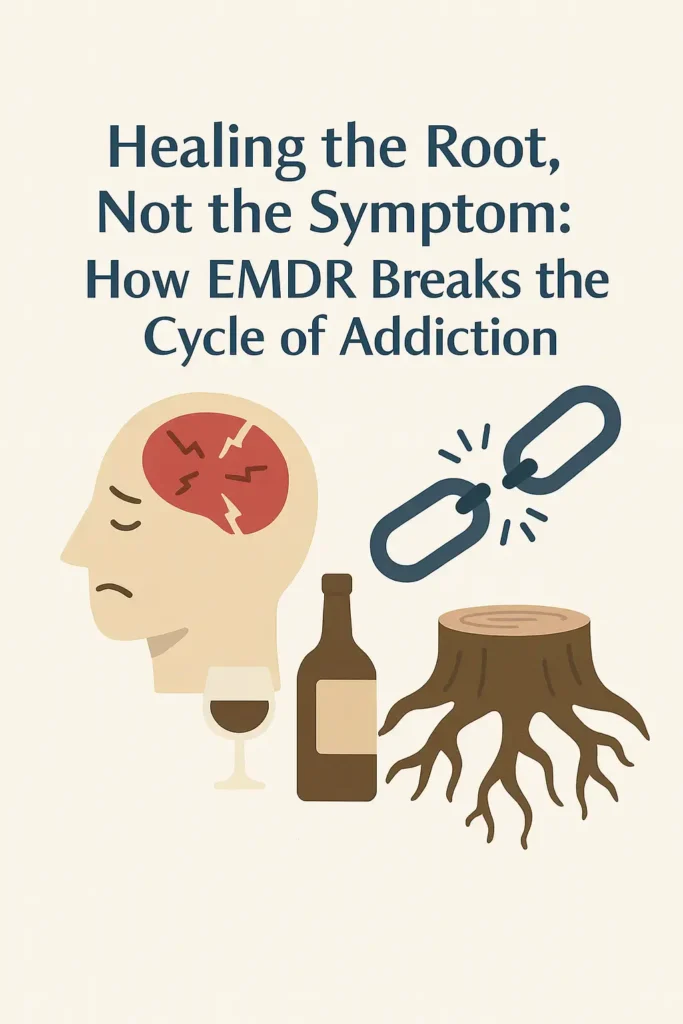
Healing the Root, Not Just the Symptom: How EMDR Breaks the Cycle of Addiction
From Trigger to Neutral Memory
For a person in recovery, a trigger can be anything—a sight, a sound, a feeling—that unleashes an overwhelming craving. Often, these triggers are unconsciously linked to past traumatic memories. EMDR directly targets this connection. During the Desensitization phase, the therapy effectively “unplugs” the intense emotional charge from the memory. The memory itself doesn’t vanish, but it is transformed. It becomes just a story from the past, rather than a terrifying event that feels like it’s happening right now. When the memory is neutralized, its power to trigger cravings is extinguished at the source. This offers a path not just to managing cravings, but to true freedom from them.
Rewriting the Internal Script
Addiction is often fueled by a painful internal script of negative self-beliefs born from trauma: “I am worthless,” “I am unlovable,” “I am permanently damaged”. These beliefs create a state of constant emotional pain that drives the need to self-medicate. The Installation phase of EMDR is designed to fundamentally rewrite this script. It doesn’t just reduce the negative; it actively strengthens and integrates a positive, adaptive belief like “I am worthy of safety,” “I survived and am strong,” or “I am in control now”. When a person truly, deeply believes they are worthy and capable, the internal motivation for self-destruction diminishes.
Building Emotional Resilience and New Coping Skills
By healing the root trauma, EMDR enhances a person’s innate ability to regulate their emotions. When the inevitable stresses of life occur, they are no longer met with a dysregulated nervous system that screams for an external solution. Instead, the individual has a greater capacity to stay present and navigate challenges without resorting to substances. The therapy itself, especially the resourcing done in Phase 2, provides a toolkit of new, healthy coping mechanisms that replace the old, destructive one, creating lasting behavioral change and building the emotional resilience needed for a sober future. This process is not about cutting a part of your life away; it is about integration. The past is not erased but is woven into your life story in a way that no longer causes harm, allowing you to become more whole and unified.
Creating the Conditions for Lasting Recovery
Why the Environment Matters for Deep Healing
A powerful therapeutic tool like EMDR is most effective when used in an environment designed to support profound healing. Recovering from the deep wounds of trauma and addiction requires more than just therapy sessions; it requires a sanctuary. It demands a space of absolute physical and emotional safety, a temporary removal from the triggers and stressors of daily life, and a comprehensive program that supports the whole person—mind, body, and spirit.
Essential Components of a Trauma-Informed Treatment Program
An environment truly conducive to healing integrates several key components:
- A Holistic, Evidence-Based Philosophy: The program must treat the entire person, not just the addiction, using scientifically supported methods.
- Integrated Treatment for Co-occurring Disorders: It is essential that a center has the expertise to treat both the SUD and the underlying trauma (like PTSD) at the same time. Addressing one without the other is a recipe for relapse.
- A Multidisciplinary Team of Experts: Lasting recovery requires a collaborative team of medical doctors, psychiatrists, clinical psychologists, and experiential therapists all working together to provide comprehensive care.
- A Nurturing and Therapeutic Setting: A serene environment, away from the chaos of one’s life, provides the peace necessary for deep internal work. The healing effects of nature, in particular, cannot be overstated.
- Focus on Somatic and Experiential Therapies: Since trauma is stored in the body, practices like yoga, meditation, sound therapy, and art therapy are vital complements to psychotherapy. They help release stored stress, regulate the nervous system, and reconnect the mind and body.
Finding Your Sanctuary for Healing
Creating this kind of healing container is the philosophy at the heart of the Costa Rica Treatment Center. It is a place that embodies these essential principles, understanding that the setting is a crucial part of the therapy itself. The commitment to a holistic, evidence-based program means that every aspect of treatment is designed to heal the underlying mental health issues that fuel addiction.
The presence of an experienced, multidisciplinary team—including medical doctors, psychiatrists, and clinical psychologists—ensures that co-occurring disorders are treated with the highest level of integrated care. The stunning natural beauty of Costa Rica is not just a backdrop but an active part of the healing process, with nature excursions and outdoor activities incorporated to restore peace and perspective. This approach is complemented by a deep focus on somatic healing through practices like yoga and sound therapy, which prepare the body and mind for the profound work of therapies like EMDR and help integrate the healing that occurs. This reframes the act of seeking help from a punishment to a proactive retreat—a courageous investment in one’s own well-being.
Building Your Sober Future: Hope and Healing Beyond Trauma
You Are More Than Your Trauma
If you are struggling with addiction, it is vital to understand that your battle is not a reflection of your character, but very often a response to the pain you have endured. Your attempts to cope are understandable. Healing is not only possible; it is your birthright. By addressing the root cause of the pain instead of just battling the symptoms, you can find a path to a more sustainable and peaceful sobriety.
A Future Defined by You
Therapies like EMDR, offered within a safe and nurturing environment, do more than just heal old wounds. They restore a sense of agency. They empower you to reprocess your past, reclaim your present, and consciously build a future that is defined by your strengths, your values, and your dreams—not by your trauma. The ultimate goal is not just to stop using substances, but to build a life that is so resilient, connected, and fulfilling that the old coping mechanisms are no longer necessary or desired.
The First Step
Taking the first step is often the hardest, but it is also the most powerful. Reaching out for help is an act of profound courage and self-worth. We encourage you to seek out trauma-informed care, to ask questions, and to give yourself the gift of a future free from the weight of the past. Healing is waiting.