Loving someone who is battling a substance use disorder is a journey of profound emotional complexity. It is a path walked through a minefield of fear, hope, frustration, and an overwhelming desire to help. You watch the person you care for struggle against a stubborn opponent, and your natural instinct is to do anything and everything in your power to protect them, to ease their pain, to fix the problem. This instinct comes from a place of deep love. Yet, in the landscape of addiction, the lines between helping and harming can become dangerously blurred. You may find yourself at…
Loving someone who is battling a substance use disorder is a journey of profound emotional complexity. It is a path walked through a minefield of fear, hope, frustration, and an overwhelming desire to help. You watch the person you care for struggle against a stubborn opponent, and your natural instinct is to do anything and everything in your power to protect them, to ease their pain, to fix the problem. This instinct comes from a place of deep love. Yet, in the landscape of addiction, the lines between helping and harming can become dangerously blurred.
You may find yourself at a painful crossroads, where your best intentions seem to yield the worst results. Actions that feel like support may, in fact, be prolonging the very crisis you wish to end. This is the confusing and heartbreaking territory of enabling. It is a trap that countless caring, well-meaning family members fall into, not out of malice, but out of love, fear, and a desperate hope for peace.
This article is intended to be a comprehensive guide for you, the person who loves someone in the grip of addiction. Its purpose is to provide clarity in the midst of chaos, to validate your experience without judgment, and to offer a practical, compassionate roadmap forward. Here, you will learn to distinguish between destructive enabling and true, healthy support. Most importantly, you will be equipped with the tools to establish healthy boundaries—the essential framework that can protect your own well-being while giving your loved one the greatest opportunity for genuine, lasting recovery.
Understanding the Enabling Trap: When Good Intentions Go Wrong
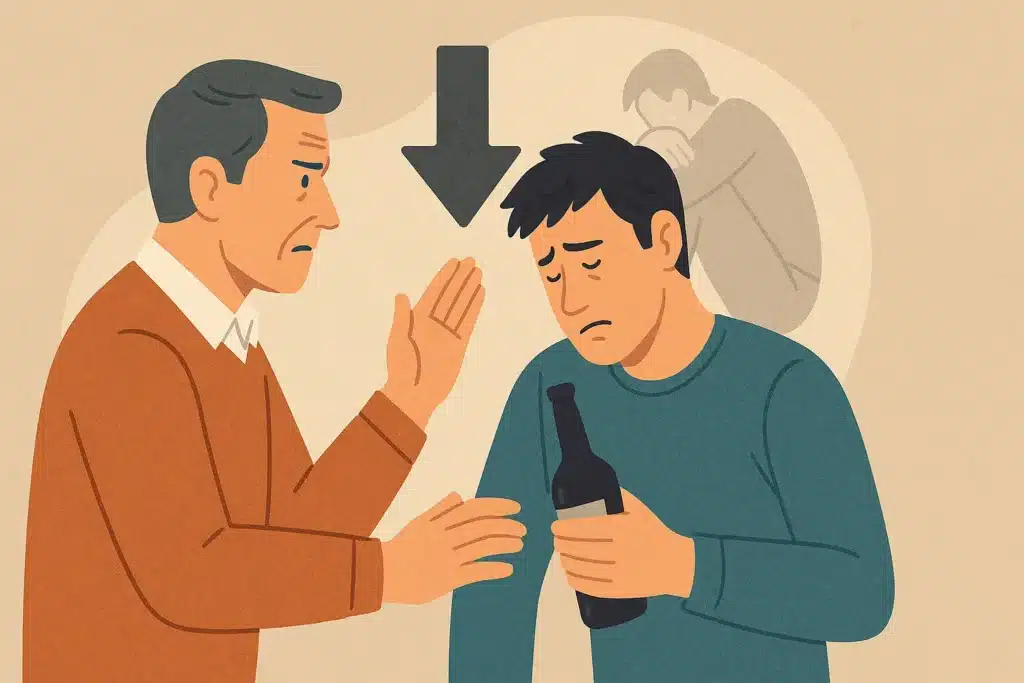
Enabling is one of the most misunderstood and challenging dynamics in addiction. It is not simply “helping too much.” According to the American Psychological Association, enabling is a process where one person’s behavior contributes to the continuation of another’s self-destructive patterns, such as substance abuse. In essence, an enabler acts as a cushion or buffer, unintentionally shielding their loved one from the natural consequences of the addiction. While the intention is to protect, the result is that the status quo—the substance use—is allowed to continue and flourish.
This dynamic is so insidious because it is often born from the most powerful human emotions. It is crucial to understand the psychology that drives these behaviors, not as a source of blame, but as a foundation for self-awareness and change.
- Love and Fear: The primary driver is almost always a profound love for the person, fused with a terrifying fear of what might happen if you stop intervening. You fear they might end up homeless, get arrested, overdose, or hit a “rock bottom” from which they can’t recover. This fear compels you to act, to solve the immediate crisis, even if it undermines the long-term solution.
- Guilt and Responsibility: Many family members carry a heavy, often misplaced, burden of guilt. You might wonder if you did something to cause the addiction, leading you to feel responsible for fixing it. This guilt can drive you to sacrifice your own time, money, and emotional energy in a futile attempt to “make up for” a problem that is not your fault.
- Conflict Avoidance: The daily reality of living with addiction is exhausting. Confrontation is painful and often feels pointless. It can be easier in the moment to give in, to make an excuse, or to ignore the problem just to “keep the peace”. This short-term relief, however, comes at the cost of long-term healing.
- Hope and Denial: It is natural to cling to the hope that your loved one will see the light and change on their own. This can lead to denial, where you minimize the severity of the problem, telling yourself “it’s not that bad” or that they are simply going through a “rough patch”. This denial allows the addiction to progress unchecked.
These powerful emotional drivers can create a systemic and destructive cycle. The dynamic often begins with a codependent mindset, where a person’s self-worth is tied to being a caretaker. This need to be needed fuels enabling actions, such as paying their bills or lying to their employer. These actions successfully shield the person from the painful consequences of their addiction, which in turn removes their primary motivation to seek help. As the addiction continues, the enabler pours more and more of their own emotional, financial, and physical resources into a failing system, leading to their own complete burnout. This creates a tragic feedback loop: the very actions meant to solve the problem end up sustaining the addiction and destroying the caregiver in the process.
To help you identify these patterns in your own life, consider the following common signs of enabling. This is not a list for judgment, but a tool for honest self-reflection.
Comprehensive Checklist: 20 Common Signs of Enabling
- Making Excuses: You consistently justify their substance use or resulting behavior by blaming stress at work, a difficult past, or other external circumstances.
- Covering Up or Lying: You lie to their employer, friends, or other family members to hide their substance use or protect them from the consequences of their actions.
- Financial Bailouts: You repeatedly pay their rent, cover their bills, pay off their debts, or settle their legal fees.
- Taking Over Responsibilities: You find yourself doing their share of household chores, managing their finances, caring for their children, or even completing their work assignments.
- Protecting Them from Consequences: You intervene to prevent them from experiencing the natural fallout of their choices, such as bailing them out of jail or hiring a lawyer to fix a DUI.
- Ignoring or Minimizing the Behavior: You act as if the problem doesn’t exist, or you downplay the severity of their substance use, insisting it’s not “that bad”.
- Blaming Others: You shift the blame for their addiction onto their friends, their boss, other family members, or even yourself, rather than holding them accountable.
- Prioritizing Their Needs Over Your Own: You consistently neglect your own physical health, emotional well-being, career, and financial stability to manage their life and crises.
- Keeping Secrets: You agree to their requests not to talk about the addiction with anyone, which isolates you both and allows the problem to thrive in darkness.
- Failing to Follow Through on Ultimatums: You frequently set rules or threaten consequences (“If you do that again, I’m leaving”) but never enforce them.
- Feeling Resentful: You experience a growing sense of anger, bitterness, and disappointment because the relationship feels completely one-sided and your efforts are not reciprocated.
- Feeling Superior or Treating Them Like a Child: You adopt a controlling, parental role, managing their life as if they are incapable, which undermines their self-respect and your own.
- Suppressing Your Own Feelings: You hide your own fear, anger, and hurt to avoid triggering a conflict or upsetting your loved one.
- Using With Them: You drink or use drugs alongside them with the rationalization that you are “monitoring” their intake or keeping them safe.
- Protecting the Family Image: Your primary concern becomes what others will think, leading you to hide the problem to protect the family’s reputation.
- Feeling Guilty When They Face Consequences: You feel an intense sense of guilt and responsibility when you don’t rescue them and they are forced to deal with the fallout of their actions.
- Justifying Their Use: You find yourself agreeing with their rationalizations, such as believing they “deserve” to drink after a hard day at work.
- Experiencing Burnout: You feel emotionally, physically, and financially exhausted from the constant cycle of crisis, rescue, and disappointment.
- Avoiding the Problem: You use your own coping mechanisms—overworking, emotional eating, taking medication—to tranquilize your own feelings and avoid confronting the reality of the addiction.
- Isolating Yourself: You withdraw from your own friends, hobbies, and support systems because you are either ashamed or completely preoccupied with your loved one’s problems.

The Hidden Toll: How Enabling Sabotages Recovery and Wounds the Family
While enabling stems from a desire to help, its consequences are profoundly damaging for everyone involved. It creates a dysfunctional system that not only fails to solve the problem but actively makes it worse, sabotaging the potential for recovery and inflicting deep wounds on the family.
For the Loved One: Removing the Motivation for Change
The most direct harm of enabling is that it removes the very motivation a person needs to seek help. Addiction is a progressive disease, and it often takes a significant crisis—the painful encounter with consequences—to break through the denial. When a person loses their job, faces legal charges, experiences financial ruin, or damages important relationships, the reality of their situation becomes undeniable. These events, while painful, can be powerful catalysts for change.
Enabling systematically dismantles these catalysts. By providing a financial safety net, making excuses to an employer, or paying for a lawyer, the enabler creates a protective bubble around the person with the addiction. Inside this bubble, they are shielded from the real-world fallout of their choices. With no compelling reason to stop, the substance use is not only allowed to continue but is given no reason to cease.
For the Family: A Cascade of Negative Effects
The person enabling the addiction pays an immense price. The constant stress and turmoil of living with active addiction, compounded by the thankless work of enabling, leads to a cascade of negative effects that can devastate a person’s life.
- Emotional and Psychological Burden: Family members are often in a constant state of high alert, experiencing a relentless barrage of anxiety, fear, worry, anger, and depression. The unpredictable nature of the loved one’s behavior leads to chronic stress, which can manifest in sleep disturbances, mental exhaustion, and even trauma-related conditions like PTSD.
- Erosion of Trust and Respect: Addiction thrives on lies, manipulation, and broken promises. As the enabler is drawn into a world of covering up and making excuses, the trust that forms the foundation of any healthy relationship is systematically destroyed. The person with the addiction loses respect for the enabler who never follows through on their word, and the enabler’s resentment builds with each betrayal.
- Financial Strain: The economic cost of enabling can be catastrophic. It includes not only the money given directly to the loved one but also the costs of legal fees, damaged property, and lost productivity for the enabler, who may miss work to deal with crises. Many have drained savings accounts, maxed out credit cards, or even mortgaged their homes in a desperate attempt to manage the chaos.
- Social Isolation: The shame and stigma associated with addiction often cause families to withdraw from their social circles. It becomes too difficult and exhausting to explain the loved one’s erratic behavior or to maintain a facade of normalcy. This leads to profound social isolation at the very time when support is needed most.
- Physical Health Decline: Chronic stress is not just an emotional state; it has severe physical consequences. The constant worry and emotional turmoil can lead to a weakened immune system, changes in weight, trouble sleeping, and an overall decline in physical health as the enabler neglects their own self-care.

The Shift to True Support: From Shielding to Empowering
Recognizing the destructive pattern of enabling is the first, most courageous step. The next is to make a conscious shift toward genuine, healthy support. This means redefining what it means to “help.” True help does not shield a person from reality; it empowers them to face it. It supports their recovery, not their addiction. It means standing beside them on their journey, not clearing the path in front of them. This kind of support encourages personal responsibility, accountability, and the pursuit of professional treatment.
The single most important tool for making this critical shift is the implementation of healthy boundaries. Boundaries are not walls you build to push a loved one away. They are not acts of punishment or abandonment. Rather, boundaries are clear, respectful limits you set for yourself to protect your own physical, emotional, and financial well-being. They are the rules you establish for your own behavior, defining what you will and will not accept in your life, thereby creating a new, healthier dynamic for the relationship.
The distinction can feel blurry in the heat of the moment, so it can be helpful to see the behaviors side-by-side.
Enabling vs. Helping in Action
| Enabling Behaviors (Shielding from Reality) | Helping Behaviors (Supporting Recovery) |
| Making excuses for their behavior (“He’s just stressed”). | Expressing your concern directly and honestly (“I am worried about your drinking”). |
| Paying their rent, bills, or legal fees. | Refusing to give money; offering to help find a treatment program instead. |
| Lying to their boss or other family members for them. | Allowing them to face the natural consequences of their actions. |
| Taking on their responsibilities (chores, work, etc.). | Encouraging them to be accountable for their own obligations. |
| Ignoring or tolerating substance use in your home. | Stating clearly that no drugs or alcohol are allowed in the house. |
| Bailing them out of jail or fixing legal problems. | Letting them experience the legal consequences of their choices. |
| Trying to control or monitor their use. | Detaching with love and focusing on your own well-being. |
| Keeping their addiction a secret to “keep the peace.” | Seeking support for yourself through Al-Anon or family therapy. |

Your Roadmap to Healthy Boundaries: A Step-by-Step Guide
Setting boundaries is a skill, and like any skill, it can be learned and practiced. It is an act of profound love—for yourself, because you deserve to live a life free from the chaos of addiction, and for your loved one, because they deserve a genuine opportunity to get well. This process requires introspection, courage, and consistency.
Step 1: Define Your Lines (Self-Reflection)
Before you can communicate a boundary, you must be crystal clear on what it is. This first step is a private process of self-reflection. It involves looking inward to identify your limits and values, separate from the needs and demands of your loved one. Take some time to honestly answer the following questions for yourself:
- What specific behaviors am I no longer willing to tolerate in my life? (e.g., being yelled at, having them use substances in my home, being lied to).
- What are my core personal values? (e.g., honesty, mutual respect, physical and emotional safety).
- What do I need to feel safe, respected, and sane in my own home and my own life?.
- What are my absolute limits emotionally, physically, and financially? Where is the line I will not allow to be crossed again?.
Step 2: Plan the Conversation (Communication Strategy)
How you communicate your new boundaries is just as important as the boundaries themselves. The goal is to be firm and clear, but also loving and respectful.
- Choose the Right Time: Plan to have this conversation when your loved one is sober and you are both as calm as possible. A moment of crisis is not the time to introduce new rules.
- Communicate with Love and Firmness: Begin the conversation by expressing your love and concern. This is not an attack; it is an act of self-preservation and a plea for a healthier relationship. As the saying goes, “Say what you mean, mean what you say, just don’t say it mean”.
- Use “I” Statements: This is the most crucial communication technique. “I” statements focus on your feelings and needs without casting blame, which is less likely to make the other person defensive. Instead of saying, “You always come home drunk and yell at me,” try, “I feel scared and hurt when you raise your voice at me after drinking”.
It is vital to understand a fundamental truth about this process. For someone accustomed to enabling, the act of setting a boundary can feel like an aggressive, controlling, and confrontational move—everything you have been trying to avoid. However, the reality is the exact opposite. Setting a boundary is an act of relinquishing control over your loved one’s addiction and reclaiming control over your own life and well-being. It is a declaration that you can no longer stop them from making their choices, but you can and will control your own environment and how you are treated. This mental shift is what makes the difficult act of setting a boundary psychologically possible. It is not an act of punishment; it is an act of profound self-respect.
Step 3: State the Boundary and the Consequence (The Formula)
A healthy boundary has two parts: the clear limit and the specific consequence if that limit is violated. The consequence must be something you have the power and, most importantly, the willingness to enforce.
- Example Script 1 (Financial Boundary): “I love you, and because I want to support your recovery, I will no longer give you money for any reason. If you ask me for money, I will have to end the conversation. I am always here to help you find a treatment program or take you to a support meeting.”.
- Example Script 2 (Behavioral Boundary): “I need our home to be a safe and sober environment. You are not allowed to use or store drugs or alcohol in this house. If I find any, I will require you to leave immediately.”.
- Example Script 3 (Emotional Boundary): “I feel disrespected and hurt when you blame me for your problems. I will no longer participate in conversations where you are blaming me. If it starts, I will walk away.”.
Step 4: The Critical Follow-Through (Consistency)
This is, without question, the most difficult and most vital step in the entire process. A boundary that is not enforced is merely a suggestion, and it teaches your loved one that your words hold no weight.
It is almost certain that your new boundaries will be tested. Your loved one may react with anger, manipulation, or guilt-tripping to see if you will back down. This is expected. Your job is to remain calm and consistent. Every single time you follow through with the stated consequence, you reinforce the new, healthy rule and rebuild your own credibility.
The failure to follow through creates a “Communication-Action Gap”—a space between what you say and what you do. This gap is more damaging than setting no boundary at all. It actively teaches the person with the addiction that your limits are negotiable and that with enough pressure, they can get what they want. It erodes their respect for you and makes it exponentially harder to set boundaries in the future. Therefore, it is better to start with a small, simple boundary that you know you can enforce 100% of the time, rather than a large, sweeping one that you might abandon. The power of a boundary lies not in its declaration, but in its consistent action.

You Don’t Have to Do This Alone: Healing the Whole Family
Embarking on this journey of setting boundaries is brave, but it is also incredibly challenging and emotionally draining. It is essential to remember that you are not expected to be a therapist or to navigate this complex process on your own. Seeking professional support is not a sign of weakness or failure; it is a sign of profound strength and a commitment to healing.
Addiction is often called a “family disease” because it does not exist in a vacuum. It profoundly impacts the entire family system, creating dysfunctional roles, breaking down communication, and wounding relationships. Just as the problem affects the whole family, the solution must also involve the whole family. This is where family therapy becomes an invaluable tool.
The evidence-based benefits of involving the family in the recovery process are significant:
- It Provides Education: A therapist can help the entire family understand the nature of addiction as a chronic brain disease, which helps to reduce the blame, shame, and stigma that so often poison family dynamics.
- It Improves Communication: Family therapy provides a safe, structured, and professionally mediated environment where members can learn to express their feelings and needs constructively, breaking old patterns of conflict and misunderstanding.
- It Identifies and Addresses Enabling: A trained therapist is an expert at identifying the very enabling behaviors discussed in this article. They can help family members recognize these patterns and replace them with healthy, supportive actions.
- It Rebuilds Trust: Healing the deep wounds of broken trust is a long process. Family therapy provides a roadmap for this journey, helping to foster accountability and rebuild strong, honest relationships.
- It Increases Treatment Success: Decades of research have shown that when families are involved in the treatment process, the person with the addiction is more likely to complete the program, stay sober, and achieve lasting recovery.
This systemic approach is why leading international treatment programs now consider family involvement to be a cornerstone of effective care. At the Costa Rica Treatment Center, we recognize that addiction is a family disease, and true, lasting recovery requires healing for the entire family unit. Our multidisciplinary team includes professionals like Mariana Charpentier, a psychologist and family therapist dedicated to healing the systemic environment of the individual. This philosophy is built directly into our programs. For example, our serene
CRTC Riverside campus explicitly offers Family Therapy as a core component of its holistic and evidence-based treatment model. By providing a dedicated space for families to learn, communicate, and heal together, we help rebuild the supportive foundation that is so crucial for a future free from addiction.
Choosing a New Path of Hope and Healing
The path you have been on has likely been one of pain, confusion, and exhaustion. The decision to stop enabling and start setting healthy boundaries is a monumental turning point. It is a choice to step out of the chaotic dance of addiction and onto a new path of self-respect and genuine love. It is not an act of abandonment, but the ultimate act of compassion—for your loved one, who deserves a real chance at a life of recovery, and for yourself, because you deserve a life of peace, safety, and well-being.
This journey will require courage, patience, and unwavering consistency. But by choosing this new path, you are not giving up on your loved one; you are finally giving both of you a chance to heal. You are replacing a dysfunctional dynamic that fuels addiction with a healthy structure that supports recovery. You are trading short-term, fragile peace for the possibility of long-term, authentic healing for your entire family.
If you recognize your family in the pages of this article, please know that support is available and that hope is real. You do not have to navigate this journey alone. Reaching out to a professional can provide the guidance, tools, and support your family needs to break the cycle and begin to heal. Contact a treatment specialist today to learn more about how family-inclusive programs can help you and your loved ones find a new way forward.