TL;DR Digital addiction is a real, brain-based condition, not a personal failing, driven by technology designed to be compulsive. True recovery goes beyond simple “detox tips” and often requires changing your environment and rewiring your brain’s reward system through proven therapies. This guide offers a clear path from understanding the signs of dependency to exploring effective treatment options, including immersive, nature-based rehab in the uniquely healing environment of Costa Rica. “Am I Addicted to My Phone?” Recognizing the Subtle Signs of a Digital Dependency If you’ve ever caught yourself scrolling at 2am instead of sleeping, you’re not alone. That quiet,…
TL;DR
Digital addiction is a real, brain-based condition, not a personal failing, driven by technology designed to be compulsive. True recovery goes beyond simple “detox tips” and often requires changing your environment and rewiring your brain’s reward system through proven therapies. This guide offers a clear path from understanding the signs of dependency to exploring effective treatment options, including immersive, nature-based rehab in the uniquely healing environment of Costa Rica.

“Am I Addicted to My Phone?” Recognizing the Subtle Signs of a Digital Dependency
If you’ve ever caught yourself scrolling at 2am instead of sleeping, you’re not alone. That quiet, almost unconscious act of reaching for your phone is a shared modern experience. But when does that habit cross a line? When does it become something more than just a way to pass the time? The conversation around digital addiction is often clouded with judgment, but the reality is a clinical one. It’s a behavioral dependency, sometimes called “nomophobia” (the fear of being without a mobile phone), characterized by a compulsive urge to use digital devices despite clear negative consequences in your life. It’s not about the number of hours you spend online, but the loss of control you feel over those hours. Recognizing the signs is the first, most powerful step toward regaining that control.
Beyond Screen Time: The Behavioral and Emotional Red Flags
A true digital dependency reveals itself not just in screen time reports, but in how it affects your behavior, your emotions, and even your physical health. Behaviorally, it often involves a constant preoccupation with being online, leading to the neglect of important duties at work, school, or home. You might find yourself hiding your usage from loved ones or losing control over your ability to stop, even when you want to.
The emotional toll is just as significant. A key sign is experiencing withdrawal—feeling anxious, irritable, or even a sense of dread when you can’t access your phone or the internet. You may start using your phone as a crutch to escape difficult feelings like boredom, stress, or loneliness, only to find that the excessive use actually amplifies those very feelings. This creates a vicious cycle where the intended solution becomes the source of the problem. One person powerfully described this paradox, noting an “obsession to respond instantly” to work messages and social media DMs, which he justified as helping his community. Yet, he admitted this constant digital engagement made him “never fully present” for his own children, leading to more frequent shouting and a deep sense of guilt. This illustrates a core truth of digital addiction: the performance of online connection often comes at the direct expense of authentic, real-world relationships.
Physically, the signs can be overt: chronic sleep deficits from late-night scrolling, persistent eye strain or headaches, and even poor posture from hunching over a screen. These symptoms are your body’s way of signaling that the balance has been lost.
A Quick Self-Check: 5 Questions to Uncover a Compulsive Habit
This isn’t a formal diagnosis, but an opportunity for honest self-reflection. Consider these five questions to better understand your relationship with technology:
- Do you lose track of time when you’re online? A common characteristic of compulsive behavior is finding that you’ve spent far more time on your device than you realized or intended.
- Do you feel anxious, irritable, or empty when you can’t access your phone or the internet? These feelings are classic signs of withdrawal, indicating that your nervous system has become dependent on the constant stimulation.
- Has your phone use interfered with your job, school, or important relationships? When digital life consistently takes priority over real-life responsibilities and connections, it’s a significant red flag.
- Do you find yourself reaching for your phone at the first sign of boredom, stress, or loneliness? Using technology to avoid or alleviate negative feelings, rather than for enjoyment or utility, is a hallmark of addictive behavior.
- Have you tried to cut back on your own but found you couldn’t? Repeated, unsuccessful attempts to control your use signal a loss of control, a key component of any addiction.
The struggle is not just about distraction. Groundbreaking research has revealed that the mere presence of a smartphone in a room—even when turned off—causes a significant decline in performance on cognitive tasks. This isn’t because of notifications; it’s because a part of your brain is actively working to inhibit the urge to check the device, imposing a constant “cognitive tax” on your mental resources. This scientific finding validates the feeling that willpower alone isn’t enough. It suggests that to truly reset, a change of environment where the device is physically absent may be necessary.
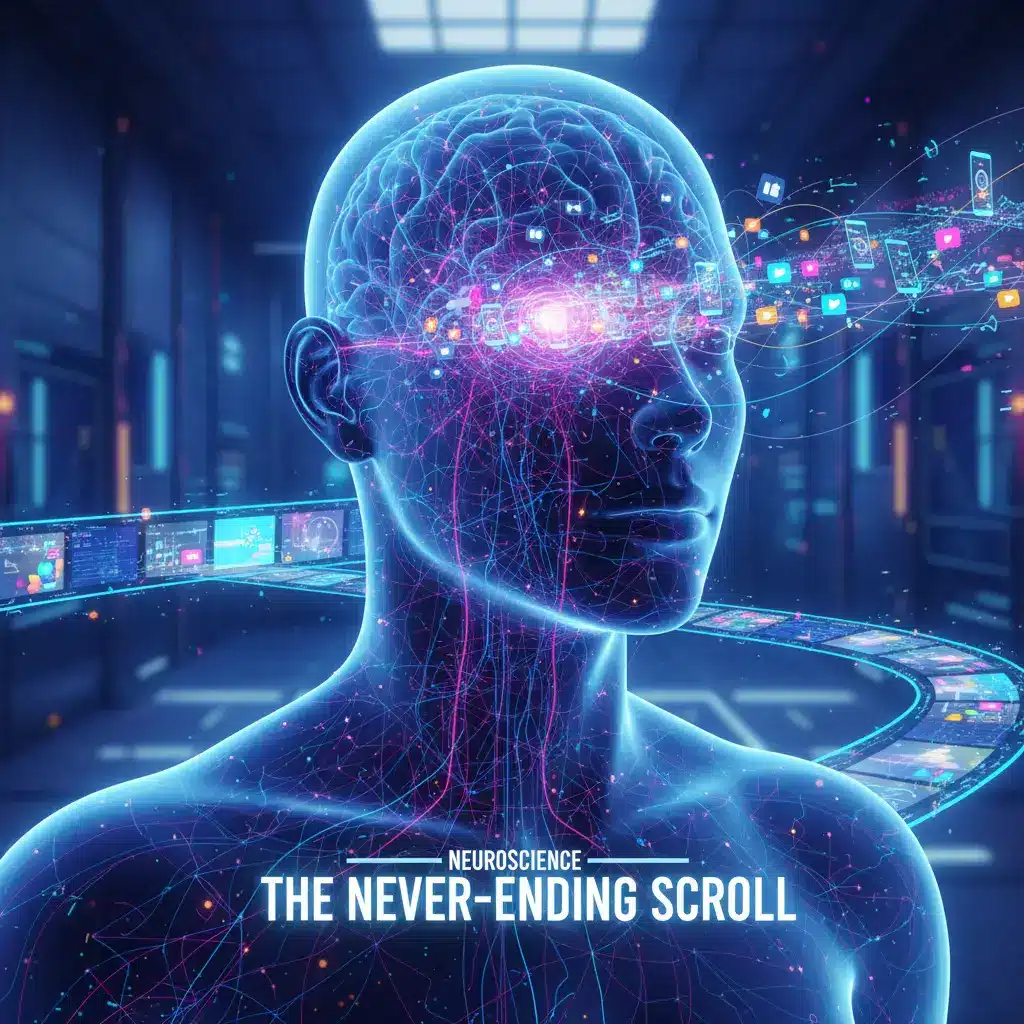
The Neuroscience of the Never-Ending Scroll: How Your Brain Gets Hooked
If you’re struggling to control your screen time, it’s crucial to understand one thing: this is not a moral failing or a lack of willpower. It is a neurobiological response to a system that has been deliberately engineered to capture and hold your attention. Understanding the science behind how your brain gets hooked can be incredibly empowering, shifting the narrative from self-blame to self-awareness and opening the door to effective solutions.
The Dopamine Loop: Your Brain on Notifications, Likes, and Infinite Feeds
Dopamine is often called the “pleasure chemical,” but a more accurate description is the “motivation chemical”. It’s the neurotransmitter that drives you to seek rewards. Digital technologies are masterfully designed to manipulate this system. They operate on a principle well-known to casino designers: variable rewards. When you pull the lever on a slot machine, you might win, or you might not. It’s this uncertainty that makes it so compelling.
Your smartphone works the same way. The “pull to refresh” feature on your email or social media feed is a digital slot machine lever. You pull it, and you might get a rewarding new email, a “like” on your photo, or nothing at all. This unpredictability, or “reward uncertainty,” causes a much stronger dopamine spike than a predictable reward would. Features like infinite scroll, autoplay, and the physiologically arousing red notification badges are all part of the “attention economy,” meticulously designed to keep you engaged by hijacking your brain’s fundamental reward pathways. It is not an accident; it is a business model.
More Than a Feeling: How Technology Physically Alters Your Brain’s Chemistry
The impact of chronic technology use goes far beyond temporary dopamine spikes. Research shows it can cause measurable, physical changes to the brain, blurring the line between a “behavioral” addiction and a substance use disorder.
One key area of impact is on the neurotransmitter GABA (gamma-aminobutyric acid), which has an inhibitory function, helping to produce calm and control anxiety. Studies of heavy smartphone users have found a disruptive ratio of GABA to other neurotransmitters, a warning sign of addiction that affects the brain’s ability to regulate itself.
Even more striking is the effect on the brain’s physical structure. A recent study that scanned the brains of individuals with phone addiction discovered a decrease in grey matter volume in critical areas responsible for controlling movement, memory, and emotions. The researchers noted that the physical shape and size of these brains resembled those of individuals with a drug addiction. This powerful finding confirms that digital addiction is not a metaphor; it is a condition with a tangible, physiological basis. This validation is critical, as it underscores the need for equally rigorous, evidence-based clinical treatment. Fortunately, the same research offers profound hope: when the subjects received Cognitive Behavioral Therapy (CBT), their brain chemistry showed a reversion back to a healthy, non-addicted state, proving that the brain can heal.

Your Path to Recovery: From a Simple Digital Detox to Immersive Rehab
Understanding the signs and the science of digital addiction naturally leads to the next question: What can be done about it? The path to recovery is not one-size-fits-all. It exists on a spectrum, from self-directed strategies to comprehensive professional treatment. Navigating this landscape requires moving beyond popular myths and understanding what level of support is right for your unique situation.
The Contrarian Truth: A Real Detox Isn’t About Less Wi-Fi, It’s About a New Environment
The term “digital detox” often conjures images of simply turning off your phone for a weekend. While this can provide temporary relief, it rarely leads to lasting change because it fails to address the root of the problem. A true, effective detox is not about temporarily reducing your access to Wi-Fi; it’s about fundamentally changing the environmental cues and behavioral patterns that drive the addiction.
Lasting recovery is about breaking the cycle where your phone is the default response to every moment of boredom, stress, or anxiety. This means consciously replacing that digital crutch with “recovery-rich” activities that nourish your well-being—things like taking a walk in nature, engaging in a creative hobby, or having a face-to-face conversation. Furthermore, research and clinical experience suggest that a gradual, tapered reduction in screen time is often more sustainable than attempting to go “cold turkey.” An all-or-nothing approach can set you up for failure, leading to feelings of shame that push you right back into the compulsive behavior you’re trying to escape. The most critical factor in early recovery is not sheer willpower but a fundamental shift in your physical and social surroundings, removing the constant triggers that deplete your mental energy.
When to Seek Professional Help: Comparing Outpatient vs. Inpatient Digital Addiction Treatment
For many, self-directed changes are not enough. When the dependency is severe, when it co-occurs with other mental health challenges like depression or anxiety, or when one’s home environment is full of triggers, professional help becomes essential. The two primary levels of care are outpatient programs and inpatient (or residential) rehab. Choosing the right one depends on an honest assessment of your needs.
| Feature | Inpatient/Residential Rehab | Outpatient Program (IOP/PHP) |
| Environment & Structure | 24/7 structured, supervised, and tech-free environment. You live at the facility, completely removed from daily triggers. | You live at home and attend treatment sessions at a facility for several hours, 3-5 days a week. |
| Intensity of Therapy | Highly intensive. Daily individual therapy, group sessions, family therapy, and holistic activities. | Less intensive but still structured. Regular group and individual counseling focused on relapse prevention and skill-building. |
| Ideal Candidate | Individuals with severe dependency, co-occurring mental health conditions (anxiety, depression), or an unstable/triggering home environment. | Individuals with mild-to-moderate dependency, a strong support system at home, and the inability to take extended time off from work or school. |
| Key Benefits | Complete removal from triggers, allowing the brain to reset. Deep, immersive focus on recovery without distractions. 24/7 medical and clinical support. | Greater flexibility, lower cost, and the ability to immediately practice new coping skills in your real-world environment. |
| Considerations | Higher cost due to room and board. Requires taking a leave of absence from work, school, and family responsibilities. | Higher risk of exposure to triggers and potential relapse. Requires a high degree of personal motivation and a stable home life to be successful. |
It’s also important to view professional treatment not as a single event, but as a continuum of care. Many of the most effective recovery journeys follow a stepped process. A person might begin with an intensive residential stay to stabilize and build foundational skills in a safe environment. From there, they may transition to a Partial Hospitalization Program (PHP) and then an Intensive Outpatient Program (IOP) as they gradually reintegrate into daily life with structured support. This approach ensures that you receive the right level of care at each stage of your journey, positioning your treatment provider as a long-term partner in your sustained well-being.

The Gold Standard: Evidence-Based Therapies for Lasting Internet Addiction Recovery
Effective treatment for digital addiction is not based on guesswork. It relies on a set of scientifically validated therapeutic models that have been proven to help individuals understand their triggers, change their behaviors, and build a foundation for lasting recovery. These evidence-based approaches provide the clinical backbone for any reputable treatment program, ensuring that you are not just disconnecting from your devices, but actively rewiring the neural pathways that created the dependency in the first place.
Cognitive Behavioral Therapy (CBT): Rewiring the Thoughts That Drive the Urge
Cognitive Behavioral Therapy (CBT) is widely recognized as the gold-standard treatment for technology and internet addiction. Its power lies in its practical, skills-based approach. CBT operates on the principle that our thoughts, feelings, and behaviors are interconnected. For digital addiction, the therapy helps you identify the specific, often automatic, negative thoughts and distorted beliefs that trigger the compulsive urge to go online.
These might be thoughts like, “If I don’t check my email right now, something terrible will happen,” or “I feel lonely, scrolling through social media will make me feel connected”. A therapist works with you to challenge the validity of these thoughts and systematically reframe them into more realistic and healthier alternatives. Through this process, you learn to break the conditioned link between a trigger (like a feeling of anxiety) and the response (compulsive phone use), effectively rewiring the brain’s habitual patterns and building new, adaptive coping mechanisms.
Mindfulness & Group Therapy: Finding Presence and Connection Beyond the Screen
While CBT provides the tools to change your thoughts, mindfulness provides the awareness to notice them in the first place. Mindfulness is the practice of paying attention to the present moment—to your thoughts, feelings, and bodily sensations—without judgment. For someone struggling with digital addiction, this practice is transformative. It helps create a crucial “pause” between the moment an urge to check your phone arises and the automatic action of picking it up. In that pause, you regain the power of choice. Techniques like mindful breathing, body scan meditations, and simply noticing your surroundings help train your brain to find calm and focus without external digital stimulation.
This internal work is powerfully complemented by group therapy. The isolation and loneliness that often fuel digital addiction cannot be healed alone. Group therapy provides a safe, professionally facilitated space to share experiences, combat shame, and build the very skills that have been eroded by excessive screen time: face-to-face communication, empathy, and vulnerability. It serves as a “relational corrective” to the distorted, superficial connections of the online world. By fostering a sense of belonging and mutual accountability within a therapeutic community, group therapy directly addresses the core human need for authentic connection that the internet promises but so often fails to deliver.

The Costa Rica Advantage: Why Your Environment is the Most Powerful Tool for Healing
Where you choose to heal can be just as important as how you choose to heal. The principles of recovery—changing your environment, practicing mindfulness, and building real connection—are not abstract concepts. They are experiences. At Costa Rica Treatment Center, we have built our entire philosophy around the understanding that the right environment can be the most powerful catalyst for profound and lasting change. The unique combination of our pristine natural setting, evidence-based clinical care, and the country’s inherent cultural ethos creates a healing synergy that cannot be replicated elsewhere.
Nature as Co-therapist: The Science of Ecotherapy in a Biodiverse Paradise
Ecotherapy, or nature-based therapy, is an evidence-based modality that leverages the healing power of the natural world. This is not simply about having a nice view from the window; it is an active clinical intervention that helps reverse the neurological damage caused by digital addiction.
One of the core principles at play is Attention Restoration Theory, which posits that our capacity for directed attention—the kind we use to focus on work, read, and resist distractions—is a finite resource that becomes severely depleted by the constant stimulation of screens. Natural environments, with their gentle, fascinating stimuli (the sound of a bird, the pattern of light through leaves), engage our “involuntary attention.” This allows our depleted directed-attention “muscles” to rest and recover. The sheer biodiversity of Costa Rica makes this process incredibly effective; the constant stream of novel sights and sounds stimulates curiosity and wonder, restoring cognitive clarity and focus.
Scientifically, the benefits are clear. Time spent in nature has been shown to significantly reduce levels of cortisol (the body’s primary stress hormone), lower blood pressure, and boost the production of mood-regulating neurotransmitters like serotonin. At our center, this science is put into practice through immersive activities like guided forest bathing (shinrin-yoku), adventure therapy on mountain hikes, and equine therapy, all of which are designed to reconnect you with the natural world and, in doing so, with yourself.
Living the “Pura Vida” Prescription: How a Culture of Simplicity Heals the Stressed Mind
“Pura Vida,” or “pure life,” is more than Costa Rica’s national slogan; it’s a cultural ethos that permeates every aspect of daily existence. It represents a deep-seated emphasis on simplicity, gratitude, strong community bonds, and a slower, more deliberate pace of life. This lifestyle stands in stark contrast to the very forces that drive digital addiction: the frantic pace, the pressure for constant productivity, the endless pursuit of external validation, and the profound sense of social isolation.
Immersing yourself in this culture acts as a form of “ambient therapy.” The principles you work to build in clinical sessions with your therapist—mindfulness, gratitude, connection—are modeled all around you, 24 hours a day. When you see local people (Ticos) deriving immense joy from a shared meal, a simple conversation, or a sunset, it provides powerful, real-world proof that a fulfilling life exists beyond the screen. This cultural immersion doesn’t just support therapy; it accelerates it, helping you internalize new, healthier ways of thinking and being.
Your Sanctuary for Change: Reconnecting with Yourself at Costa Rica Treatment Center
The journey of recovery is a journey back to yourself. It requires a space where the noise of the digital world fades away, allowing your own inner voice to be heard. Costa Rica Treatment Center is designed to be that sanctuary. Here, the three pillars of healing converge: clinical excellence in therapies like CBT; a powerful natural environment that actively restores your mind; and a supportive cultural ethos that reminds you of life’s simple joys. In our serene and private setting, nestled in the stunning Atenas mountains, you are given the safety, support, and tools you need to do the deep work of healing.
If you feel lost in the endless scroll and are ready to find a different path, we invite you to step out of the digital noise and into a world of real connection, profound healing, and lasting recovery.
Frequently Asked Questions (FAQs)
1. Can you really go to rehab for a phone or internet addiction? Yes. As this guide shows, digital addiction is a recognized behavioral addiction with measurable effects on the brain, similar to substance use disorders. Professional rehab provides the structured, tech-free environment, evidence-based therapies, and expert support needed to address the root causes of the addiction and build skills for lasting recovery.
2. What happens during a digital detox rehab program? A typical day in a residential program is highly structured to replace compulsive digital habits with healthy routines. It often includes individual therapy (like CBT), group therapy sessions, holistic practices such as mindfulness and yoga, and experiential therapies like nature immersion, art therapy, or equine therapy. The cornerstone of the program is the complete removal of personal digital devices, which allows the brain to reset and enables a full focus on healing within a supportive community.
3. How long does treatment for technology addiction typically take? The length of treatment varies based on individual needs, but residential programs often last for 30, 60, or 90 days. This duration provides sufficient time for the brain’s reward pathways to begin healing, for new, healthy habits to become ingrained, and for underlying issues to be addressed. Effective recovery is a long-term process, and an inpatient stay is often followed by a step-down to outpatient support to ensure a successful transition back to daily life.
4. Does insurance cover treatment for digital addiction? Coverage for digital addiction is an evolving area. While “Internet Addiction Disorder” is not yet a formal diagnosis in the primary diagnostic manual, the DSM-5, treatment is frequently covered by insurance. This is because compulsive technology use often co-occurs with diagnosable and coverable conditions like major depressive disorder, anxiety disorders, or impulse-control disorders. The best course of action is to contact a treatment center’s admissions team, who can help you verify your insurance benefits confidentially.
5. What is the difference between a bad habit and a true technology addiction? The critical distinction lies in the elements of compulsion and negative consequences. A bad habit is an action you may do too frequently, but you still feel in control of it. An addiction involves a loss of control, where you feel a compulsive urge to engage in the behavior and are unable to stop, even when you recognize it is causing significant harm to your mental health, relationships, career, or other important areas of your life.
6. How does nature therapy in Costa Rica specifically help with screen addiction? Nature therapy in Costa Rica provides a multi-layered healing experience. Neurologically, the rich, natural environment helps restore your brain’s depleted capacity for focus and attention (a concept known as Attention Restoration Theory). Biochemically, it is proven to reduce stress hormones like cortisol and boost mood-regulating neurotransmitters. Behaviorally, it replaces passive screen time with engaging, life-affirming activities like hiking, surfing, or gardening, which build confidence, foster social connection, and create a new foundation for a fulfilling, sober life.
7. What is the first step I should take if I think I have a problem? The first and most courageous step is to acknowledge your concerns without judgment. The second is to seek a professional assessment from a qualified mental health professional or an addiction specialist. A confidential conversation with an expert can help you understand the severity of the issue, identify any co-occurring conditions, and receive a recommendation for the most appropriate level of care for your specific situation, whether that is outpatient counseling or a comprehensive residential program.