If you are reading this, you or someone you love may be feeling trapped in a cycle that seems impossible to break. The grip of addiction can feel absolute, a relentless pattern of thoughts, cravings, and behaviors that operate on autopilot. It is a deeply isolating and painful experience, often accompanied by the belief that this is just “who I am now.” But what if that feeling of being stuck wasn’t a reflection of your character or a life sentence, but rather the result of deeply ingrained, yet changeable, wiring in your brain? The journey to lasting recovery is not…
If you are reading this, you or someone you love may be feeling trapped in a cycle that seems impossible to break. The grip of addiction can feel absolute, a relentless pattern of thoughts, cravings, and behaviors that operate on autopilot. It is a deeply isolating and painful experience, often accompanied by the belief that this is just “who I am now.” But what if that feeling of being stuck wasn’t a reflection of your character or a life sentence, but rather the result of deeply ingrained, yet changeable, wiring in your brain?
The journey to lasting recovery is not merely a test of willpower against a formidable foe. It is a constructive, biological process of healing and rebuilding. It is about fundamentally changing the brain’s pathways, dismantling the well-worn roads that lead to substance use, and paving new ones that lead to health, resilience, and freedom. This is not a hopeful metaphor; it is a scientific reality.
This process of rebuilding requires a blueprint, a set of tools, and a skilled guide. Cognitive Behavioral Therapy (CBT) is one of the most powerful, evidence-based, and practical therapeutic approaches available today, providing that very blueprint. It is a structured, goal-oriented therapy that has successfully helped millions of people reclaim their lives from addiction, anxiety, depression, and trauma.
In this comprehensive guide, we will explore the core principles of CBT, delving into what it is and how it works. We will then journey into the incredible science of neuroplasticity to understand how CBT literally rewires the brain. Finally, we will examine the specific tools and techniques that make CBT a cornerstone of effective addiction treatment, and why the environment in which this healing occurs is so critically important. You are not broken; you are capable of profound change, and the journey begins with understanding the blueprint for a new beginning.

Decoding CBT: A Practical Guide to Changing Your Mind
At its heart, Cognitive Behavioral Therapy is a form of psychotherapy, or “talk therapy,” that is grounded in a simple but profound idea: the way we think and what we do affects the way we feel. Unlike some therapies that focus extensively on digging into the distant past to find the roots of a problem, CBT is practical, collaborative, and focused on solving problems in the here-and-now. It is designed to equip you with a set of skills to manage your thoughts and actions, empowering you to become your own therapist over time.
The CBT Triangle: Thoughts, Feelings, and Actions
The core concept of CBT can be visualized as a triangle, with thoughts, feelings (emotions and physical sensations), and actions (behaviors) at each point. These three elements are intrinsically linked and constantly influence one another in a continuous cycle. In the context of addiction, this cycle can become a powerful, self-perpetuating trap.
Consider this common scenario for someone struggling with alcohol addiction:
- The Situation: You receive a stressful email from your boss criticizing a recent project.
- The Automatic Thought: An immediate, uninvited thought flashes through your mind: “I can’t handle this pressure. I’m going to fail. I’m not good enough. I need something to take the edge off and just forget about this for a while”. This is often called an Automatic Negative Thought, or ANT.
- The Feelings: This thought triggers a cascade of painful emotions—shame, overwhelming anxiety, hopelessness. You might also notice physical sensations like a knot in your stomach or a racing heart. These feelings intensify the desire for relief.
- The Action: To self-medicate these distressing feelings, you act on the craving. You stop at a bar on the way home or pour a drink as soon as you walk in the door. The temporary relief reinforces the belief that the substance is a necessary coping tool, strengthening the entire cycle for the next time a trigger appears.
CBT works by helping you intervene at key points in this cycle. It teaches you how to press pause, become aware of the automatic thought, and actively challenge it. By changing the unhelpful thought (“I’m a failure”) and the subsequent behavior (drinking), you can fundamentally alter the painful feelings that result, breaking the cycle and building a new, healthier one.
What to Expect in a CBT Session: A Collaborative Partnership
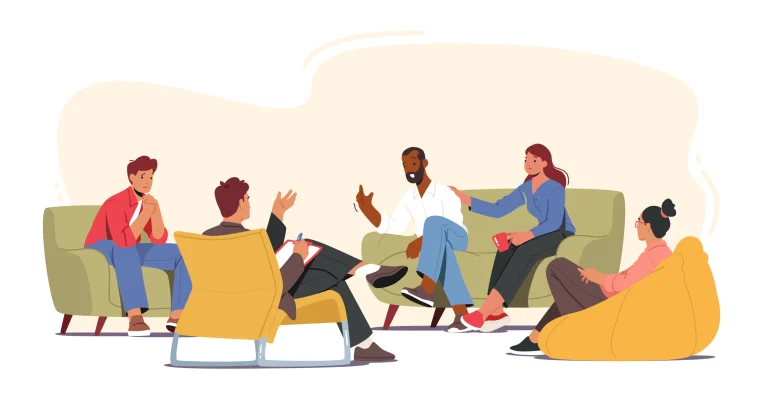
A common misconception about therapy is that it involves passively talking while a therapist listens. CBT sessions are the opposite; they are active, structured, and collaborative. Your therapist acts as a skilled partner and coach, working alongside you to achieve your goals. The process is transparent and logical, typically following a clear structure.
The journey usually begins with Assessment and Goal Setting. Together with your therapist, you will identify the specific problems and challenges you want to address. This isn’t a vague conversation; it involves setting clear, measurable, and achievable goals for your recovery. For example, a goal might be “to manage work-related stress for 30 days without using alcohol” rather than just “to stop drinking.”
Next, you will learn to Identify Your Patterns. A central part of the work is developing self-awareness. Your therapist will teach you how to monitor your own thoughts, feelings, and behaviors to see the connections that fuel your addiction. This often involves practical exercises like keeping a thought record or a journal, which helps bring unconscious patterns into conscious awareness.
The majority of the therapy is dedicated to Skills Training and Practice. This is where CBT truly distinguishes itself. The therapy session is where you learn the tools, but the real change happens when you apply them in your daily life. Your therapist will teach you specific cognitive and behavioral techniques and then, crucially, you will be asked to practice them between sessions. This “homework” is not supplemental; it is the central mechanism of the therapy. Just as a physical therapist would give you exercises to strengthen a muscle, a CBT therapist gives you mental and behavioral exercises to strengthen your mind. It is this consistent practice that transforms the patient from a passive recipient of treatment into an active, empowered participant in their own healing.
How CBT is Different: Focusing on the Here-and-Now
While understanding how past experiences have shaped you can be valuable, CBT’s primary focus is on the present. The core question in CBT is not “Why am I this way?” but rather “What is keeping me stuck right now, and what can I do about it?” This forward-looking approach is incredibly empowering for individuals who may feel defined and burdened by past mistakes.
Furthermore, CBT is typically a short-term, time-limited therapy. The goal is not to keep you in therapy indefinitely. Instead, it aims to provide you with a durable set of coping skills as efficiently as possible, so that you can face future challenges with confidence long after the sessions have ended. It is a therapy model built on the principle of self-efficacy—the belief in your own ability to manage your life.

The Science of Hope: How Your Brain Can Heal and Rewire Itself
The principles of CBT are psychologically powerful, but their true impact is rooted in biology. The most hopeful message from modern neuroscience is that the brain is not a static, unchangeable organ. The damage caused by addiction is not a permanent state. Your brain has a remarkable, innate capacity to heal, adapt, and change throughout your entire life. This phenomenon is called neuroplasticity.
Introducing Neuroplasticity: Your Brain is Not Hardwired
For decades, it was believed that the adult brain was largely fixed. We now know this is untrue. Neuroplasticity is the brain’s ability to reorganize its structure, functions, and connections in response to new experiences, learning, and even injury. This process is governed by a simple but powerful principle often summarized by the phrase: “Neurons that fire together, wire together”.
Imagine your brain’s connections as a network of trails through a dense forest. Every time you have a thought, feel an emotion, or perform an action, you send a signal down a specific neural pathway, like walking down one of these trails. The first time, the path is faint and difficult to traverse. But if you walk that same path over and over again, it becomes wider, clearer, and easier to follow. Eventually, it becomes a well-worn road, your brain’s default route. This is neuroplasticity in action.
How Addiction Creates “Superhighways” in the Brain
Chronic substance use is an intense, repetitive experience that powerfully exploits the brain’s neuroplastic nature. Each time a substance is used to cope with a trigger, it sends a massive surge of neurochemicals through the brain’s reward pathways. This repeated activation forges an incredibly strong and efficient neural circuit—a mental “superhighway”.
Over time, this addiction superhighway becomes the brain’s path of least resistance. When faced with stress, sadness, or a trigger, the brain automatically and rapidly defaults to this pathway, generating intense cravings and compulsive urges. The brain becomes so efficient at this pattern that it can even begin to process negative information more easily than positive information, creating the cognitive distortions and pessimistic outlook that are so common in addiction. This is why breaking free feels so difficult; it’s not a lack of willpower, but a battle against a deeply embedded, highly efficient biological circuit.
CBT as the “Construction Crew” for New Neural Roads
If addiction builds a superhighway, then CBT provides the construction crew to build new roads. The therapy is a form of structured, intentional brain training. Every time you engage in a CBT technique, you are consciously choosing not to travel the old addiction highway and are instead beginning to forge a new, healthier neural path.
When you identify an automatic negative thought and challenge it, you are firing a new circuit in your prefrontal cortex. When you choose a healthy coping skill—like meditation or exercise—instead of using a substance, you are strengthening an alternative behavioral pathway. At first, these new paths are like those faint trails in the forest—they require effort and concentration to use. But with consistent practice—the “homework” that is central to CBT—these new trails get wider and stronger. With enough repetition, they become the new, well-worn roads. Simultaneously, the old addiction superhighway, through disuse, begins to narrow and fade in a process called “synaptic pruning”. This is the literal, physical “rewiring” of the brain. You are not just changing your mind; you are changing the physical structure of your brain.
A Look Inside the Brain: Remodeling Key Structures
This rewiring process isn’t just a metaphor; it’s a demonstrable biological event that can be observed with modern neuroimaging technology. Research shows that CBT leads to tangible changes in the structure and function of key brain regions involved in addiction.
- The Prefrontal Cortex (The “CEO”): Located at the front of the brain, the prefrontal cortex is your executive control center. It’s responsible for rational decision-making, impulse control, problem-solving, and regulating emotions. In addiction and trauma, this area can become underactive, weakening your ability to override impulsive cravings. CBT, particularly through cognitive restructuring techniques, acts like a workout for the prefrontal cortex. By repeatedly challenging irrational thoughts and engaging in logical analysis, you strengthen these executive circuits. Studies have shown that CBT can lead to an increase in gray matter volume and metabolic activity in the prefrontal cortex, enhancing your ability to think clearly and regulate your behavior.
- The Amygdala (The “Alarm System”): Deep within the brain lies the amygdala, your emotional alarm system. It’s responsible for generating feelings of fear, anxiety, and threat. In addiction, the amygdala becomes overactive and hypersensitive, sounding the alarm in response to triggers and flooding you with intense cravings and negative emotions. CBT techniques, especially those involving gradual exposure to feared situations, work to recalibrate this system. Over time, these practices help diminish the amygdala’s overactivity, teaching it that it doesn’t need to sound the alarm so intensely. This leads to a reduction in fear, anxiety, and the emotional intensity of cravings.
The biological engine driving these structural changes is a remarkable protein called Brain-Derived Neurotrophic Factor (BDNF). You can think of BDNF as a kind of “Miracle-Gro for your neurons.” It plays a crucial role in promoting the survival, growth, and maturation of brain cells and in fostering the creation of new synapses (connections between neurons). Exciting research has demonstrated that engaging in psychotherapy, including CBT, can increase the brain’s production of
BDNF. This provides the essential biological fuel needed for neuroplasticity to occur, allowing the hard work you do in therapy to translate into lasting, physical changes in your brain’s architecture. This connection from a psychological exercise to a molecular cascade is the ultimate proof that recovery is a physical process of brain remodeling, offering concrete, scientific hope that healing is not only possible but is your brain’s natural design.
The CBT Toolkit for Addiction Recovery
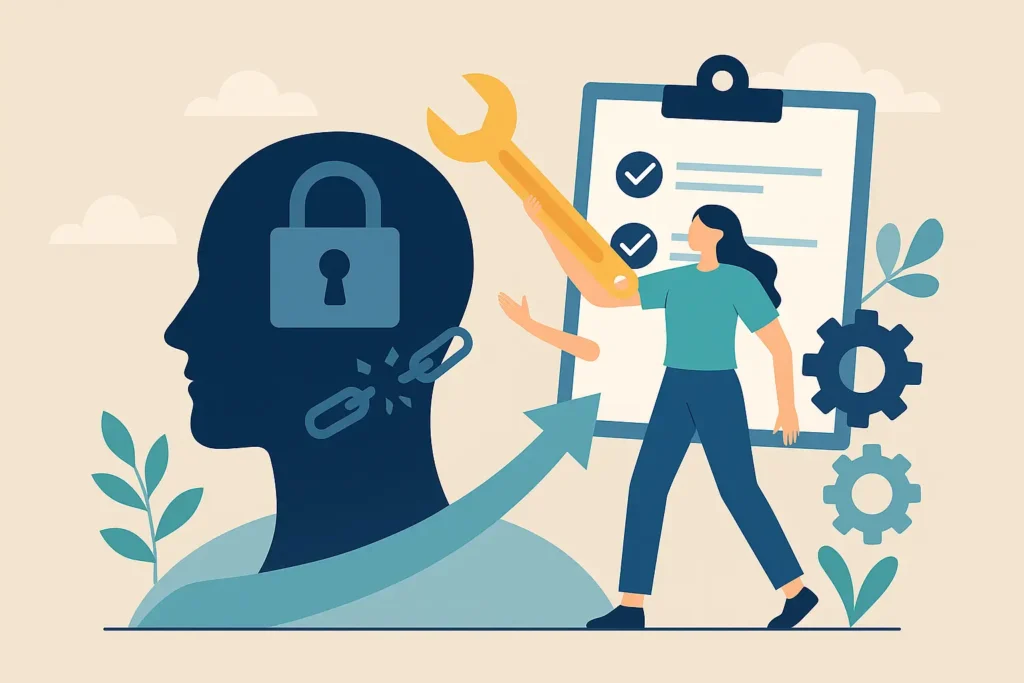
Understanding the theory of CBT and the science of neuroplasticity is empowering. But the real transformation happens when these concepts are translated into practical, actionable skills. In addiction treatment, CBT is not an abstract discussion; it is a hands-on training program that provides you with a concrete set of tools to dismantle the machinery of addiction and build a life that is more rewarding than substance use.
The overarching goal is to replace a passive, reactive coping mechanism (substance use) with an active, intentional set of problem-solving skills. Sobriety, through the lens of CBT, is not simply about the absence of a substance. It is about the presence of a new, more effective system for living. It is a positive, constructive project of building a better life, rather than a negative, restrictive one focused only on avoidance. This reframing makes recovery a far more motivating and sustainable endeavor.
The table below outlines some of the core techniques in the CBT toolkit. It translates clinical terms into practical actions, showing you exactly what you will learn to do to take control of your recovery.
The CBT Toolkit: From Automatic Reactions to Intentional Recovery
| Technique | Purpose | In Practice (Example for Addiction) |
| Functional Analysis (Trigger Mapping) | To identify the specific thoughts, feelings, and situations (internal and external) that lead to substance use. This creates a clear map of your personal addiction cycle. | You keep a detailed journal or “thought record.” You discover that the trigger is not just “stress,” but specifically the feeling of loneliness on Friday nights. This feeling leads to the thought, “No one cares about me, so what’s the point?” which in turn leads to the behavior of isolating and using a substance. |
| Cognitive Restructuring | To challenge and reframe the automatic negative thoughts (ANTs) and false beliefs that fuel addiction. This is the process of deconstructing faulty thoughts and rebuilding them in a more balanced and realistic way. | When the thought “I’ve relapsed, so all my progress is lost and I’m a total failure” arises, you learn to stop and question it. You gather evidence for and against the thought. You replace it with a more constructive one: “A setback is not the same as failure. This is a chance to learn what went wrong. I can get back on track, and this doesn’t erase the sober time I achieved”. |
| Coping Skills Development | To build a robust set of healthy, alternative behaviors to manage stress, cravings, and difficult emotions. This toolbox includes a wide range of practical strategies. | Instead of using a substance when a craving hits, you have a pre-planned list of alternatives. You could practice a 10-minute mindfulness meditation to ride out the urge, call a supportive friend, engage in vigorous exercise to change your brain chemistry, or immerse yourself in a hobby you enjoy. This also includes learning broader life skills like effective communication and assertiveness training. |
| Relapse Prevention Planning | To anticipate high-risk situations and create a proactive, step-by-step plan to navigate them successfully. This moves you from a reactive to a strategic mindset, maintaining long-term recovery. | You know an old friend’s wedding is coming up, which will be a high-risk environment. You work with your therapist to create a detailed plan: you will drive yourself so you can leave when you want, you will tell the bartender to serve you only soda with lime, you will have a few pre-written “no thank you” responses ready, and you will have a check-in call with your sponsor scheduled for immediately after you leave. |
These tools work together to create a comprehensive system for recovery. Functional analysis gives you the awareness, cognitive restructuring gives you control over your thoughts, coping skills give you healthy alternatives, and relapse prevention gives you a plan for the future.

The Power of Place: Creating the Right Environment for Change
The internal work of rewiring your brain through CBT is profoundly powerful, but it does not happen in a vacuum. Neuroplasticity is shaped by our total environment and all of our experiences. Trying to forge new neural pathways while still immersed in a high-stress, trigger-filled daily life can feel like trying to build a sandcastle while the tide is rushing in. This is why the environment in which you choose to heal is not just a backdrop for therapy; it is an active and essential component of the treatment itself.
Why Your Environment is a Key Ingredient in Recovery
Scientific research has identified several key factors that maximize brain health and create the fertile ground upon which neuroplasticity can flourish. These include quality sleep, good nutrition, regular physical activity, effective stress management, and supportive social relationships. When these elements are missing—as they often are in a life consumed by active addiction—the brain’s capacity to change and heal is compromised.
A residential treatment program provides a crucial, temporary separation from the triggers, stressors, and environmental cues that reinforce the addiction cycle. It creates a safe, structured, and supportive “laboratory” where you can focus entirely on your recovery. In this protected space, you can practice the new skills learned in CBT without the constant pressure of old habits and high-risk situations, giving those new neural pathways a chance to form and strengthen.
A Holistic Ecosystem for Healing
The most effective treatment centers understand that recovery is a holistic process. They recognize that every aspect of a person’s day can either support or hinder the work of rewiring the brain. This philosophy moves beyond simply offering therapy sessions and instead focuses on creating a complete therapeutic ecosystem designed to optimize neuroplasticity.
At specialized centers like the Costa Rica Treatment Center, this philosophy is put into practice by creating a comprehensive healing environment. Here, evidence-based therapies like CBT are not delivered in isolation. They are seamlessly integrated with nutritional guidance designed to provide the brain with the fuel it needs to build new connections, physical wellness programs and sports activities that are proven to boost BDNF production, and the profound healing effects of a serene, natural setting far from the chaos of daily life. This approach recognizes that the services often considered “ancillary” are, in fact, evidence-supported interventions that create the ideal biological and psychological conditions for CBT to be maximally effective.
Furthermore, healing is fostered through connection. A supportive, English-speaking community of peers and a high staff-to-patient ratio ensure that you are surrounded by the positive, encouraging relationships that are critical for brain health and successful therapy. Removing yourself from a toxic environment and immersing yourself in one designed for healing is a strategic decision to give your brain the best possible chance to change. It is an investment in creating the optimal conditions for the architect—you—to do your best work.
You Are the Architect of Your Future
The journey through this guide has revealed a profound truth: recovery from addiction is not a passive waiting game or a battle of brute force. It is a constructive, scientific process of rebuilding your own mind. CBT is the blueprint, providing the evidence-based strategies and skills to guide the work. Neuroplasticity is the science, confirming your brain’s incredible, innate capacity to heal and change.
You are the architect.
The feelings of being trapped and powerless are real, born from neural superhighways built over months or years. But they are not permanent. Every time you challenge a negative thought, choose a coping skill over a craving, or practice a new, healthy behavior, you are laying the foundation for a new way of being. You are actively taking the tools of CBT and using them to rewire the very structure of your brain. Lasting change is not a distant hope; it is a biological reality that you have the power to create.
Taking the first step is often the hardest. It requires courage to acknowledge the need for help and to believe that a different future is possible. But reaching out for professional guidance is not a sign of weakness. It is the first, powerful act of an architect picking up their tools, ready to build a new life. In the right environment, with the right blueprint and a supportive crew, a profound and lasting transformation is not just possible—it is waiting for you.