Yes, you can use your VA benefits for international rehab through the Foreign Medical Program (FMP), but only for a service-connected condition. For veterans whose substance use is linked to a primary service-connected disability like PTSD, the FMP can cover high-quality, inpatient treatment abroad. Costa Rica Treatment Center is the premier international choice for veterans, offering an affordable, accredited, and supportive environment to begin your recovery journey. Understanding Your Options: Does the VA Pay for Out of Country Rehab? The short answer is yes, the Department of Veterans Affairs (VA) can pay for rehabilitation treatment outside of the United States.…
Yes, you can use your VA benefits for international rehab through the Foreign Medical Program (FMP), but only for a service-connected condition. For veterans whose substance use is linked to a primary service-connected disability like PTSD, the FMP can cover high-quality, inpatient treatment abroad. Costa Rica Treatment Center is the premier international choice for veterans, offering an affordable, accredited, and supportive environment to begin your recovery journey.
Understanding Your Options: Does the VA Pay for Out of Country Rehab?
The short answer is yes, the Department of Veterans Affairs (VA) can pay for rehabilitation treatment outside of the United States. But it’s not through the programs most veterans are familiar with from their time stateside. If you’ve used VA healthcare in the U.S., you have likely heard of the MISSION Act or VA Community Care programs, which allow you to see civilian doctors under certain circumstances. It’s a common and understandable assumption that these same programs would extend to care overseas. However, this is a critical misunderstanding that can lead to confusion and frustration.
The VA system is divided into different programs for different situations, and the benefits you use at home do not apply abroad. For veterans seeking medical care, including substance abuse treatment, in a foreign country, there is a specific and separate program designed for this exact purpose: the Foreign Medical Program, or FMP. This program is the one and only VA pathway for using your earned benefits to cover the cost of international rehab. Understanding how the FMP works is the first and most important step in exploring your options for a new beginning outside the country. This guide will walk you through exactly what the FMP is, who qualifies, and how you can use it to access world-class care.
The Foreign Medical Program (FMP): Your Gateway to Using VA Benefits for Rehab Abroad
The Foreign Medical Program is your key to unlocking VA-funded treatment internationally. It operates differently than traditional insurance or other VA programs, offering a unique combination of freedom and responsibility. Getting a firm grasp on its structure is essential.
What is the FMP? A Plain-Language Explanation
Think of the FMP not as an insurance plan, but as a payment program. It is specifically designed for veterans with VA-rated, service-connected disabilities who are living or traveling outside the U.S.. Through the FMP, the VA assumes payment responsibility for medically necessary treatment of those specific disabilities.
One of the most significant advantages of the FMP is the freedom it provides. Unlike many healthcare networks in the U.S., the FMP does not have a list of “in-network” or “approved” providers. You have the freedom to choose any licensed healthcare provider in the foreign country where you are seeking care. No referral or pre-authorization is needed from the VA to begin treatment, which removes a major administrative barrier and puts you in control of your healthcare decisions.
However, this autonomy comes with a critical consideration. The FMP is primarily a reimbursement-based program. In many cases, the veteran is expected to pay the international provider for the services upfront and then file a claim with the VA for reimbursement. This means you must have the financial means to cover the initial cost of treatment while you wait for the VA to process your claim. This reality makes finding a high-quality, affordable treatment center a crucial part of the planning process.
Who is Eligible for FMP Coverage?
Eligibility for the Foreign Medical Program is straightforward but strict. It all comes down to one non-negotiable requirement: you must be seeking treatment for a VA-rated, service-connected disability.
The FMP will only cover care for an illness or injury that the VA has officially recognized as being caused or made worse by your military service. The program also covers treatment for any other condition that is medically determined to be associated with and aggravating your service-connected disability. For example, if you have a service-connected diagnosis of PTSD, the FMP may cover treatment for non-service-connected depression if it is found to be aggravating the PTSD.
Once you register for the program, the VA will send you a benefits authorization letter. This document is important because it officially lists the specific service-connected conditions that are covered under the FMP, so you know exactly what the VA will pay for.
What Services Are Covered for International Treatment?
The FMP covers a wide range of medically necessary services for the treatment of your service-connected conditions. For veterans seeking help with substance use and mental health, the covered services are comprehensive and designed to support a full recovery.
Key covered services include:
- Inpatient Hospital Care and Rehabilitation: This includes the cost of staying in a residential treatment facility for addiction and mental health recovery.
- Mental Health and Substance Abuse Treatment: The FMP specifically includes reviews of claims for mental health and substance abuse services, confirming their eligibility for coverage when linked to a service-connected disability.
- Medically Necessary Prescription Medications: The program covers prescriptions needed to treat your condition, provided the drugs are approved by the U.S. Food and Drug Administration (FDA).
- Rehabilitative Therapies: Services like physical therapy, occupational therapy, and other supportive treatments are also covered when they are part of your comprehensive treatment plan.
This broad coverage ensures that veterans can access a full continuum of care at an international facility, from initial detox and inpatient treatment to ongoing therapeutic support.
The Critical Hurdle: Connecting Your Recovery to Your Service
The entire framework of the Foreign Medical Program rests on the foundation of service connection. For a veteran seeking addiction treatment, this presents a unique and often misunderstood challenge. Your access to this benefit is not determined by the severity of your addiction, but by your ability to officially link it to your military service through the VA’s specific administrative process. This is, without question, the most important step in your journey.
Why Your Substance Use Must Be a “Secondary Service-Connected” Disability
The VA has specific rules regarding substance use disorders (SUD). Due to a law passed in 1990, the VA is prohibited from granting a direct service connection for a disability that results from a veteran’s own alcohol or drug abuse, which it may classify as “willful misconduct”. This means you cannot simply claim that your addiction began in the service and get it covered.
However, the VA also recognizes a crucial reality: many veterans turn to substances as a way to cope with the pain, trauma, and stress of other service-connected conditions. In these cases, the substance use disorder is not the original problem, but a consequence of it. Therefore, a veteran can claim SUD as a secondary service-connected disability. This is the established and accepted pathway for receiving VA benefits and FMP coverage for addiction treatment. You must be able to prove that your SUD is the result of, or was made worse by, an existing primary service-connected disability.
Common Primary Conditions That Can Link Your SUD to Your Service
For many veterans, the connection between their service and their substance use is clear. The key is to have the primary condition officially recognized by the VA. Some of the most common primary service-connected disabilities that lead to SUD as a secondary issue include:
- Post-Traumatic Stress Disorder (PTSD): This is the most frequent link. Veterans often use alcohol or drugs to self-medicate the symptoms of PTSD, such as hypervigilance, anxiety, intrusive memories, and difficulty sleeping.
- Chronic Pain or Physical Injury: A veteran with a service-connected back injury, for example, may be prescribed opioid painkillers. Over time, a legitimate medical need can develop into a dependency or addiction. In this case, the SUD is a direct result of managing the primary service-connected injury.
- Depression, Anxiety, and Other Mental Health Conditions: Any service-connected mental health condition can create a situation where a veteran turns to substances to manage their symptoms, establishing a clear link for a secondary claim.
What Evidence You Need for a Secondary SUD Claim
To successfully file a claim for SUD as a secondary condition, you must provide the VA with clear and compelling evidence that establishes the connection. The burden of proof is on you, and a strong claim is built on three pillars of evidence:
- A Medical Nexus Letter: This is the most powerful piece of evidence you can provide. It is a detailed statement from a qualified doctor, psychiatrist, or psychologist who has reviewed your records. The letter must state their professional medical opinion that it is “at least as likely as not” that your substance use disorder was caused by or is a symptom of your primary service-connected condition.
- Medical Records: You will need your official medical records showing the diagnosis for both your primary service-connected disability (like PTSD) and your substance use disorder.
- Lay Statements (Buddy Letters): These are written statements from people who know you well, such as your spouse, family members, friends, or fellow service members. These letters can be incredibly effective at painting a picture for the VA. They can describe the changes they observed in your behavior and substance use after your service or after the onset of your primary condition, helping to establish a timeline and a clear pattern.
Navigating the VA disability claims process is the true first step toward getting international rehab funded. Your eligibility for care is ultimately dependent on your success in this administrative process. This means that before you can focus on healing in a new environment, you must first focus on getting your VA claims in order.
VA Community Care, the MISSION Act, and International Treatment
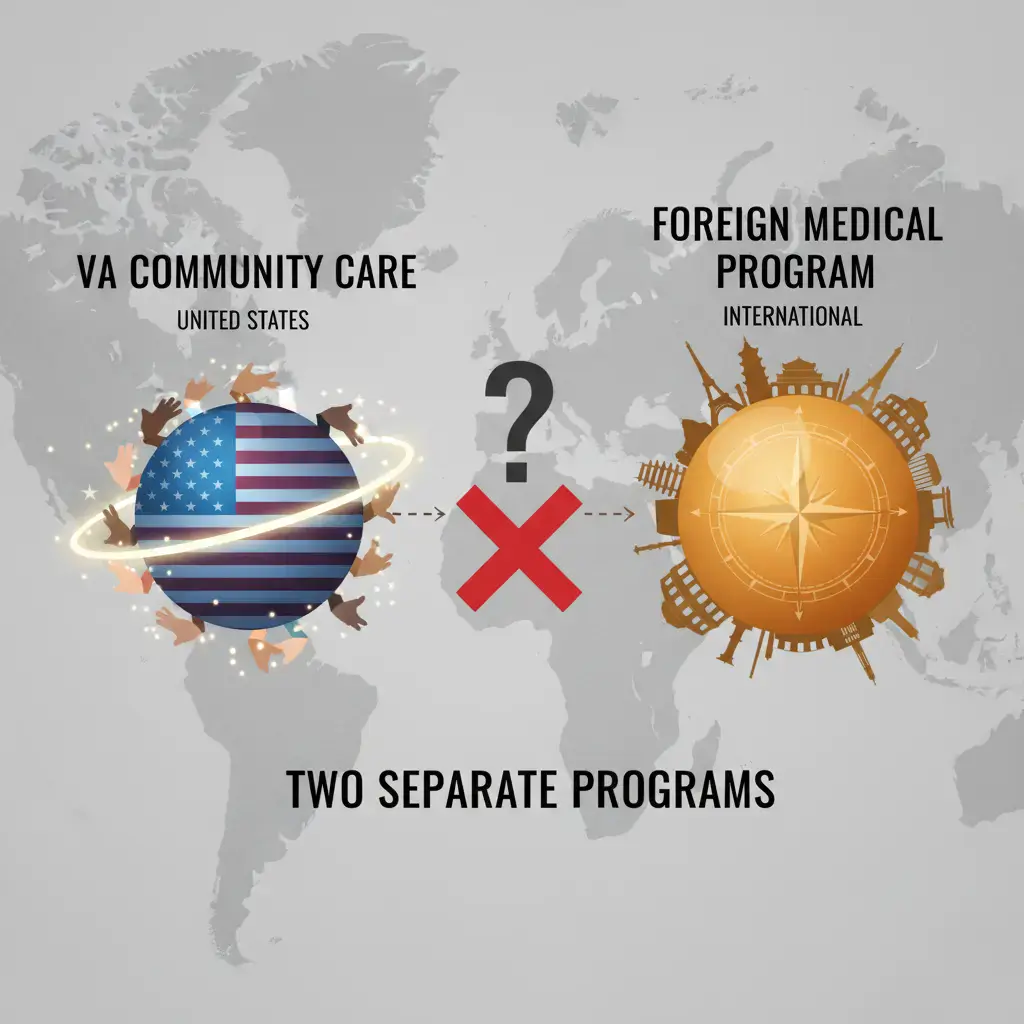
One of the most common points of confusion for veterans exploring their options is the difference between the VA MISSION Act and the Foreign Medical Program. A search for “VA community care international treatment” is common, but it leads down the wrong path. It is vital to understand that these are two entirely separate programs that operate in different parts of the world.
The VA MISSION Act of 2019 was a landmark law that consolidated the VA’s community care programs, making it easier for veterans to get healthcare from civilian providers within the United States. It is designed to supplement VA care when a local VA facility has long wait times, is too far away, or doesn’t offer the specific services a veteran needs.
The MISSION Act and its community care benefits do not apply to healthcare received in foreign countries.
The Foreign Medical Program (FMP) is the only VA program that pays for medical care for service-connected disabilities received outside of the U.S.. The table below breaks down the essential differences.
| Feature | Foreign Medical Program (FMP) | VA Community Care (MISSION Act) |
| Geographic Coverage | International (Outside the U.S.) | United States Only |
| Primary Purpose | Care for service-connected disabilities abroad | Supplements VA care within the U.S. |
| Provider Network | Any licensed foreign provider | VA-approved network of community providers |
| Authorization | No pre-authorization required | VA authorization required before treatment |
Understanding this distinction is critical. It saves you time and prevents the frustration of trying to use a U.S.-based benefit for international care. For rehab abroad, the FMP is your one and only route.
Your Step-by-Step Guide to Using VA Benefits for Rehab Abroad
Once you understand the programs and requirements, the process can be broken down into a clear, actionable plan. This step-by-step guide transforms the complex VA system into a manageable path forward.
Step 1: Establish Secondary Service Connection for SUD
This is the mandatory starting point. Before you do anything else, you must have your substance use disorder officially recognized by the VA as secondary to a primary service-connected disability. If you have not already done so, your first action is to file this disability claim with the VA, providing the necessary evidence, including a strong medical nexus letter. Without this, the FMP cannot be used for addiction treatment.
Step 2: Register for the Foreign Medical Program (FMP)
Once your SUD is service-connected, the next step is to register for the FMP. This is a simple process that can be done online, by mail, or by fax. You will need to complete and submit
VA Form 10-7959f-1, FMP Registration Form. It is important to know that you do not have to wait for your official FMP authorization letter to arrive in the mail before you seek treatment. You can receive care and file a claim as soon as you are registered.
Step 3: Choose a High-Quality, Licensed International Center
With the FMP, you have the freedom to choose your provider. When making this critical decision, look for a facility that is fully licensed and accredited by the health authorities in its country. It is also wise to select a center that has experience treating the core issues that veterans face, such as trauma and co-occurring mental health disorders. A small but important practical tip is to choose a provider who can supply your medical records and billing statements in English. While the VA will translate documents, submitting them in English can significantly speed up the claims processing time.
Step 4: Pay for Treatment and File for Reimbursement
After receiving care, you or your provider will need to file a claim with the FMP for reimbursement. The claim must include the FMP Claim Cover Sheet (VA Form 10-7959f-2) along with all required supporting documents.
Be prepared to submit:
- An itemized billing statement from the provider.
- Proof that you paid the provider (such as a receipt or a bill marked “paid”).
- A hospital discharge summary for inpatient care.
- Copies of any prescriptions for medication.
You must file your claim within two years of receiving the care. The administrative burden for a successful claim rests heavily on the veteran and the chosen provider. A treatment center that is willing and able to help you gather this documentation is not just a convenience—it’s a crucial ally in ensuring you are properly reimbursed for the care you have earned.
Why Veterans Choose Costa Rica Treatment Center for a New Beginning
Choosing to travel for treatment is a powerful commitment to your recovery. It’s a decision to step away from everything that fuels the cycle of addiction and create the space needed for true healing. At Costa Rica Treatment Center, we provide the ideal environment for this transformation, combining world-class clinical care with a setting that promotes peace and self-reflection.
A Healing Environment: Get Away from Triggers to Truly Recover
For many veterans, especially those with PTSD, the home environment is filled with triggers—people, places, sounds, and routines that are tied to trauma and substance use. Traveling for rehab is a strategic therapeutic decision to physically remove yourself from these triggers, allowing you to focus entirely on your recovery without distraction. Our centers, located in the serene and beautiful landscapes of Costa Rica, provide a peaceful sanctuary where this deep, uninterrupted healing can happen.
Internationally Accredited Care You Can Trust
Your peace of mind is our priority. Costa Rica Treatment Center is a fully licensed and accredited facility, ensuring you receive care that meets the highest international standards. We are:
- Licensed by the Costa Rican Ministry of Health: This signifies that we meet stringent government standards for safety, quality, and clinical excellence.
- Approved by the Institute of Alcoholism and Pharmacological Dependence (IAFA): As the foremost authority on addiction treatment in Costa Rica, IAFA accreditation confirms our adherence to ethical, evidence-based practices.
- Staffed by Licensed Professionals: Our multidisciplinary team includes psychologists and nurses who are members of their respective professional colleges, guaranteeing expert and ethical care.
Your Partner in Navigating the FMP Process
We understand that navigating VA paperwork from another country can seem daunting. Our team has extensive experience working with international clients and is prepared to be your partner in the FMP claims process. We provide all the necessary documentation for your claim—including detailed, itemized bills and comprehensive treatment summaries—in English to help ensure your reimbursement is processed as smoothly and quickly as possible. We are here to remove barriers, not create them.
World-Class Treatment That’s Financially Accessible
We believe that high-quality addiction treatment should be within reach. The reality of the FMP’s reimbursement model means veterans often need to cover treatment costs upfront. Our programs are offered at a fraction of the cost of comparable residential facilities in the United States and Canada, which can often exceed $20,000 per month. This affordability makes the initial investment more manageable, reducing financial stress and allowing you to focus on what truly matters: your recovery.
Frequently Asked Questions
Q: Does the VA pay for travel to an international rehab center?
A: The Foreign Medical Program (FMP) generally does not cover travel costs. However, under the separate Veteran Readiness and Employment (VR&E) program, travel expenses for rehabilitation may be authorized in specific cases, which would require close coordination with your VR&E case manager.
Q: Do I need pre-approval from the VA to get treatment at Costa Rica Treatment Center?
A: No. Under the Foreign Medical Program (FMP), you do not need a referral or pre-authorization for care. You have the freedom to choose any licensed provider, like Costa Rica Treatment Center, for your service-connected condition.
Q: What happens if my substance abuse is not service-connected?
A: The Foreign Medical Program (FMP) will only cover treatment for VA-rated service-connected conditions. If your substance use is not secondarily service-connected, the FMP would not apply. However, our team at Costa Rica Treatment Center can discuss our affordable private pay options with you.
Q: Is the MISSION Act the same as the Foreign Medical Program?
A: No. The MISSION Act and its VA Community Care programs are for receiving care from non-VA providers within the United States. The Foreign Medical Program (FMP) is the specific VA benefit that covers medical care for service-connected disabilities outside of the U.S..
Q: How do I prove my PTSD caused my substance abuse for a VA claim?
A: You need to establish a medical nexus. This typically requires a report or letter from a qualified doctor or psychologist who reviews your case and provides a professional opinion linking your substance use disorder directly to the symptoms and challenges of your service-connected PTSD.
Q: Will Costa Rica Treatment Center help me with the paperwork for my FMP claim?
A: Yes. Our team is experienced in working with international clients and can provide you with the detailed, itemized medical bills and treatment summaries in English that you need to submit a complete and accurate claim for reimbursement to the VA’s Foreign Medical Program.
Q: What if my FMP claim is denied?
A: If you disagree with a decision on your FMP claim, you have the right to appeal. You must mail a letter requesting an appeal to the VHA Office of Integrated Veteran Care within one year of the decision date, including any new information that supports your claim.
Q: Are the therapies at Costa Rica Treatment Center effective for veteran-specific issues like trauma?
A: Yes. Our holistic, evidence-based approach is designed to treat co-occurring disorders, including the underlying trauma that often fuels addiction in veterans. We provide a safe, supportive environment to address these core issues as part of a comprehensive recovery plan.